Shucking RM SEAFOOD For Good

(These mollusks left us shell-shocked)

The best thing about the meal was the waitress.

She was tall, and none too young, and spoke with a middle European accent. But she was also fast and funny and not too friendly. When you needed something, it appeared quickly, and when you needed her, she always seemed to show up a moment before the thought occurred to you.

Would that the food had measured up to the service.

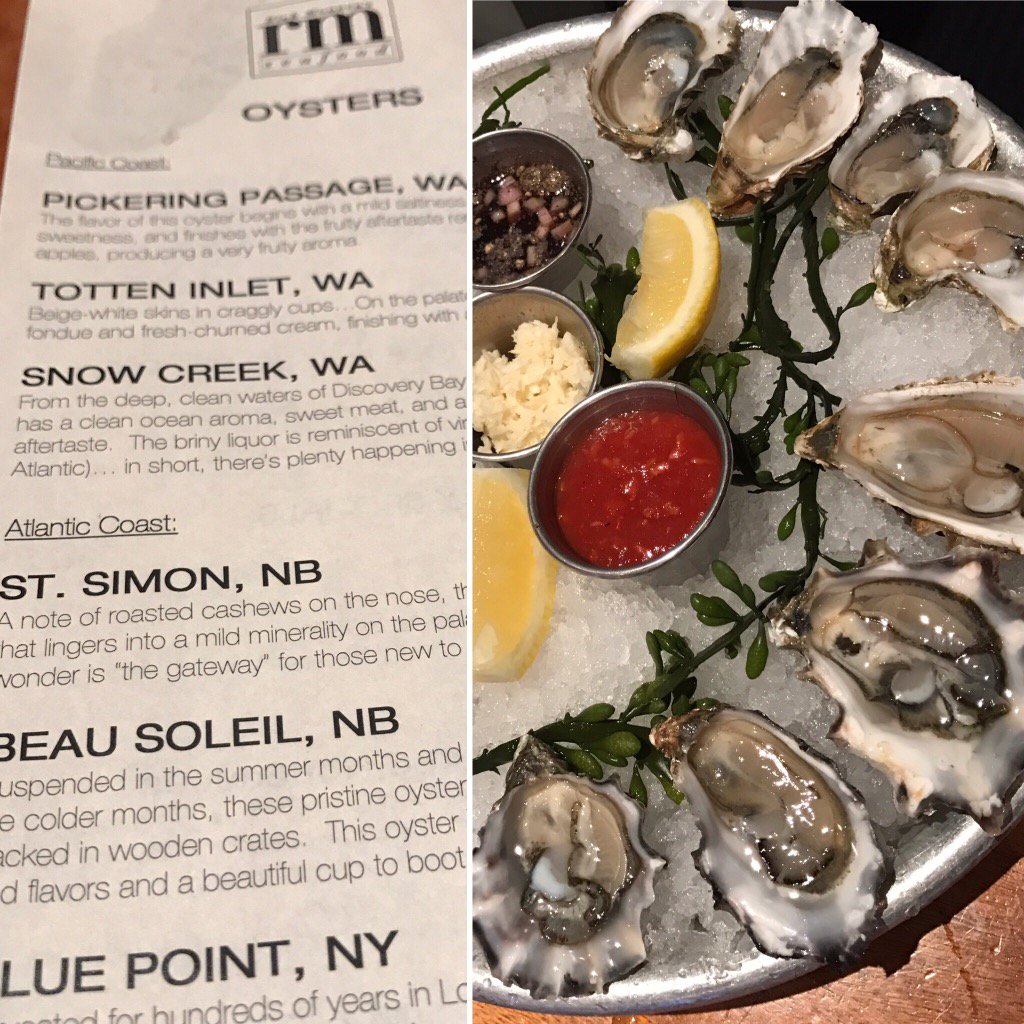
Why had we come? Why, for the oysters, of course! (See above)

Eighteen of them. A dozen mixed from the Pacific Northwest and half-dozen Bluepoints, just for comparison.

What showed up were eighteen blands that barely tasted of bivalve.

Seventy bucks of Crassostrea gigas bivalve to be exact. Tasting of nothing but old, over-chilled, mollusks.

See those fancy descriptions beside each of the varieties in the picture?  Taste-tempting indeed they were, with promises of deep, clean brininess and top notes of fondue, sweet cream and cucumber.

Know what showed up? None of the above. Just eighteen slimy balls of stale seafood that were indistinguishable from each other. We at ELV know not from where those taste descriptors came from, but dollars to doughnuts it wasn’t from anyone associated with the restaurant.

Here’s an idea: If you’re going to use florid language to describe your food, perhaps someone in the restaurant should taste something sometime to make sure the menu matches the merchandise.

Someone should also taste the faux butter here, it having the texture, taste and tensile strength of whipped air.

The biscuits and muffins are fresh baked and addictively good, but what good is that if you’re spreading them with something that really believes it is not butter?

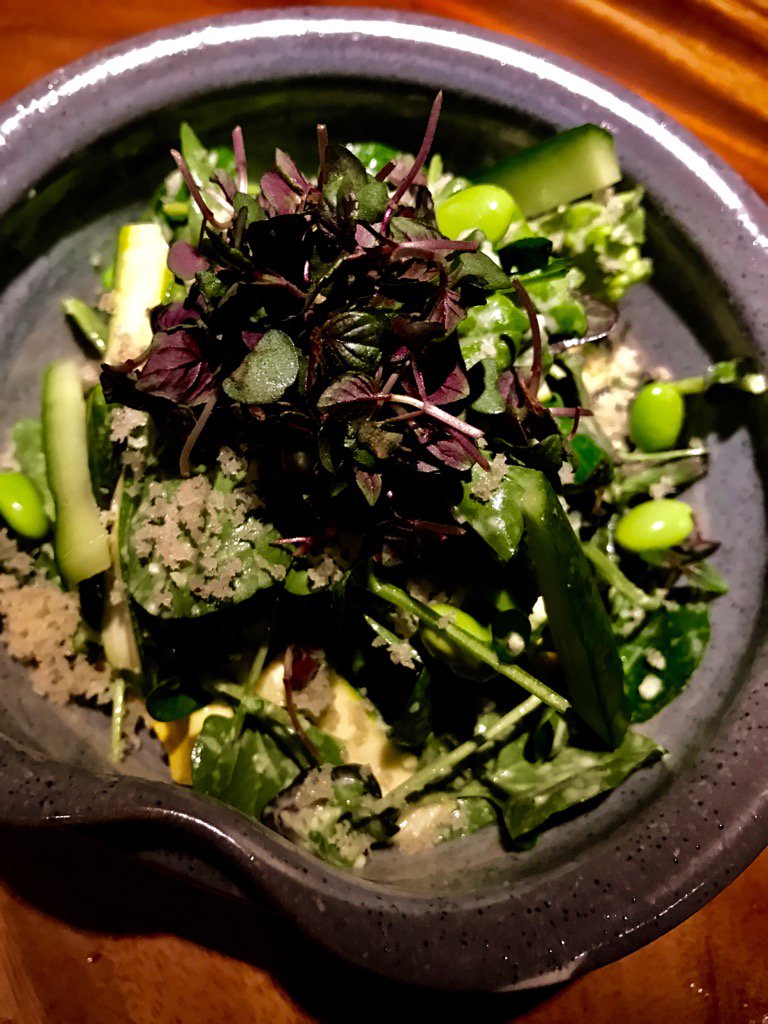
Placing these disappointments behind us, we soldiered on through the rest of the meal, “soldiering on” being the appropriate verb for having to dig through a dry, stringy crab cake, and having to use a hand grenade to soften up the hard-as-a-rock lardons that accompanied a fortress-like, inedible endive salad:
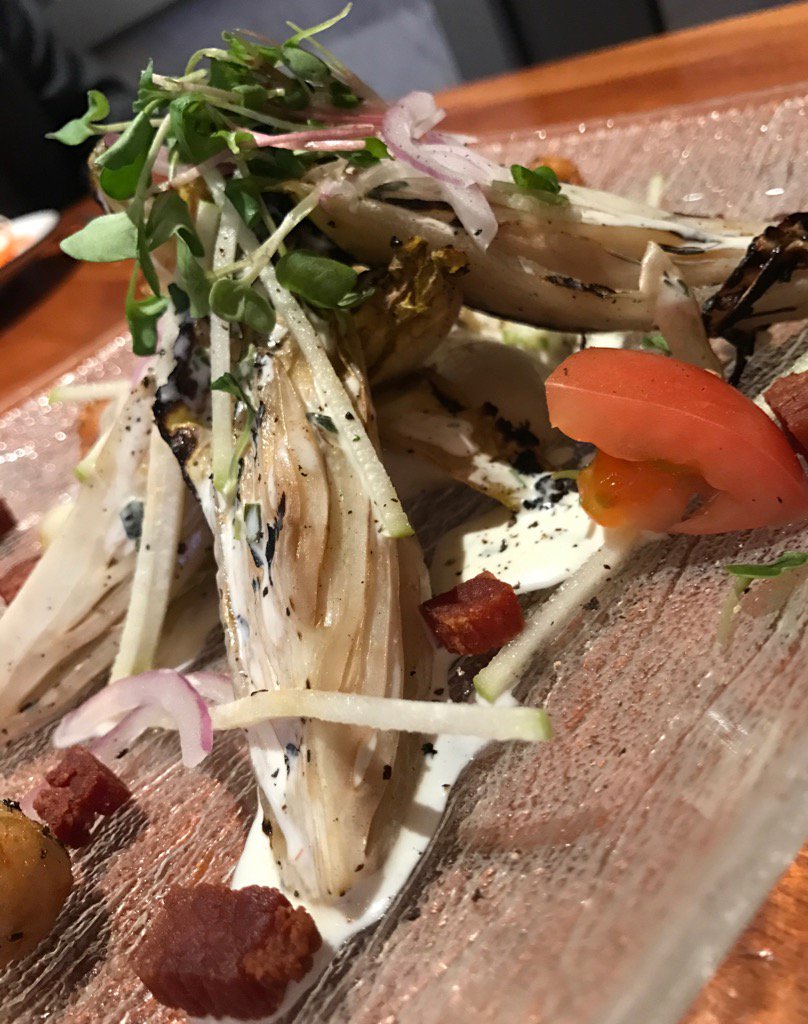
On the plus side, the tomatoes tasted like exactly what you’d expect February tomatoes to taste like, which is too say, hard, mealy and nothing at all.

Here’s an idea #2: If you’re going to serve raw endive, at least learn to dress it properly, and bring a bayonet to the table for the guests to use against it.

The meal was redeemed somewhat by a beautiful cioppino:
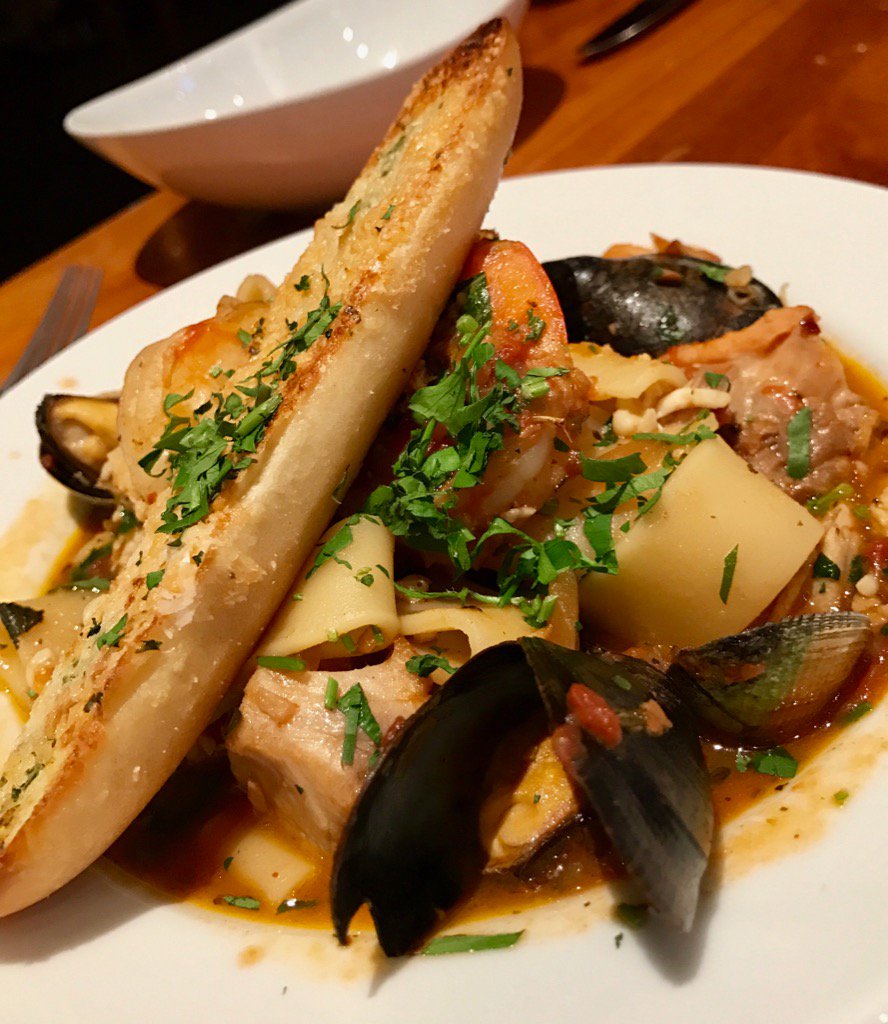
…it being full of chunks of well-chosen seafood, and dense, delicious noodles, in a piquant, rich broth. As good as it was (and it was tremendous), we were so shell-shocked by our first four courses that the breach of confidence in this kitchen could not be repaired.

We don’t know what Rick Moonen is up to these days, but from the look of things, he’s not overseeing the cooking in the restaurant that bears his name.

From the taste of things, I doubt anybody is.

Which is a pity.

Almost as pitiful as those oysters, butter, crab cake and salad.

Our dinner for two, with a single glass of wine, $70 worth of oysters and a $41 tip, came to $220.53.

RM SEAFOOD

Mandalay Bay Hotel and Casino

702.632.7200

https://www.mandalaybay.com/en/restaurants/rick-moonens-rm-seafood-fine-dining.

P.S. Some of you will no doubt notice that RM Seafood is included in our Top 50 of EATING LAS VEGAS The 50 Essential Restaurants 2017. You might also notice that it was written about in the book by my co-authors, not me. Which was the reason for my visit last week — to see if it warrants such status in future editions. I think you can guess the answer.
ZUMA-nating About Sushi

 It’s hard to get excited about big box Strip Japanese restaurants anymore.

It’s hard because they’re all clones of each other.

What Nobu started back in the late 90s has spawned copycat after copycat, until these days it’s tough to tell your Hakkasan from your Yellowtail.

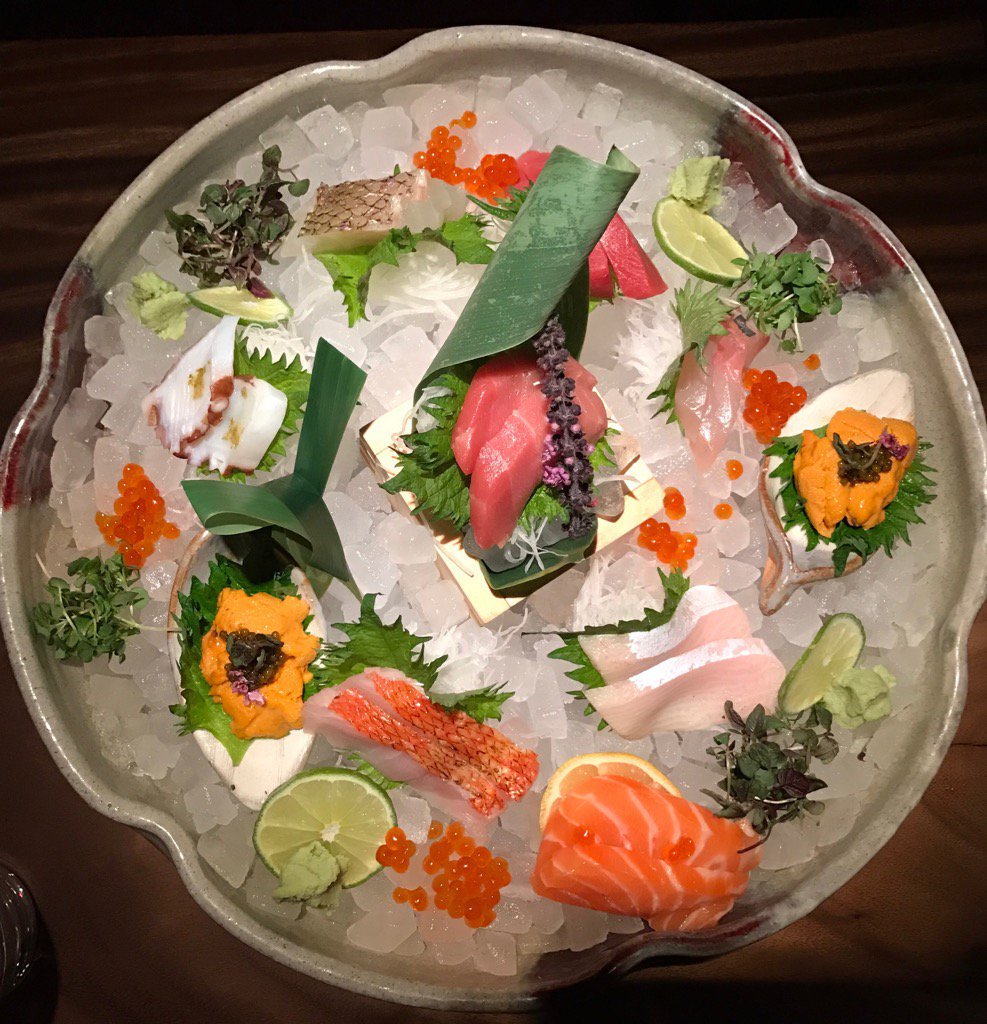
Morimoto, Nobu, and Mizumi are essentially the same restaurant. Remember Social House? That’s okay, no one else does, either. Kan’t rekall Koi? You’re not alone. Everyone of them follows the same blueprint. You’ve got your bar, your sushi bar, and your fancy steaks and your edamame. Then there’s the Japanese veggies, extravagant sushi and your robatayaki this and your yakitori  that. The only thing that’s different is whatever flourishes the chef want to add to their garnishes and presentation platters.

We ascribe this phenomenon to the improbable/ecologically indefensible rise of sushi as the protein of choice for a world looking to “eat healthier.” Ever since sushi became a “thing” around fifteen years ago, our insatiable hunger for what is, in essence, a pretty bland fish (tuna), has become the go-to ingredient for those looking to satisfy the hunger of the elite and the hoi polloi. Other fish (some of them actually tastier) are thrown into the mix, and by the time you’ve downed them, a few skewers and a “creative cocktail” or two, you’ll leave fat and happy and about $200 lighter. Which is just what the hotels want.

But here’s a dirty little secret: there isn’t a whole lot of creative cooking going on in any of them. This is formulaic food pure and simple. Putting ponzu and jalapenos on some sashimi is nothing new. In fact, it’s soooo 1996. Virtually everything else being dished up in these “modern Japanese” places is some repackaged idea the chefs learned from a Nobu Matsuhisa or Roy Yamaguchi cookbook, or from someone’s recent trip to Japan, where the chefs have been serving their minimalist food with a flourish for centuries.

(Cooking-cutter, faux creativity also being what the hotels want, the better to impress the rubes — just like they do with all those Cirque du Soleil shows. Each one assaults you with the same, idiotic acrobatics, only in different costumes; each served with different, annoying music.)

In this way have big box Japanese restaurants become the steakhouses of the 21st Century. Everyone’s doing the same thing. Everyone gets their fish from the same place; everyone’s using the same Sriracha. Only the window dressing is different.

Which brings us to Zuma. The brainchild(?) of one Rainer Becker…someone who sounds as Japanese as Fabio Trabbochi.

But we ate in his restaurant — the eleventh location, just opened in The Cosmopolitan* — and had a very good meal there.

Which is another thing about “modern Japanese” restaurants: like steakhouses, it’s pretty hard to have a bad experience in any of them. The formula is now so pat, and the techniques so well-taught, that whatever comes to your table is usually pretty tasty.

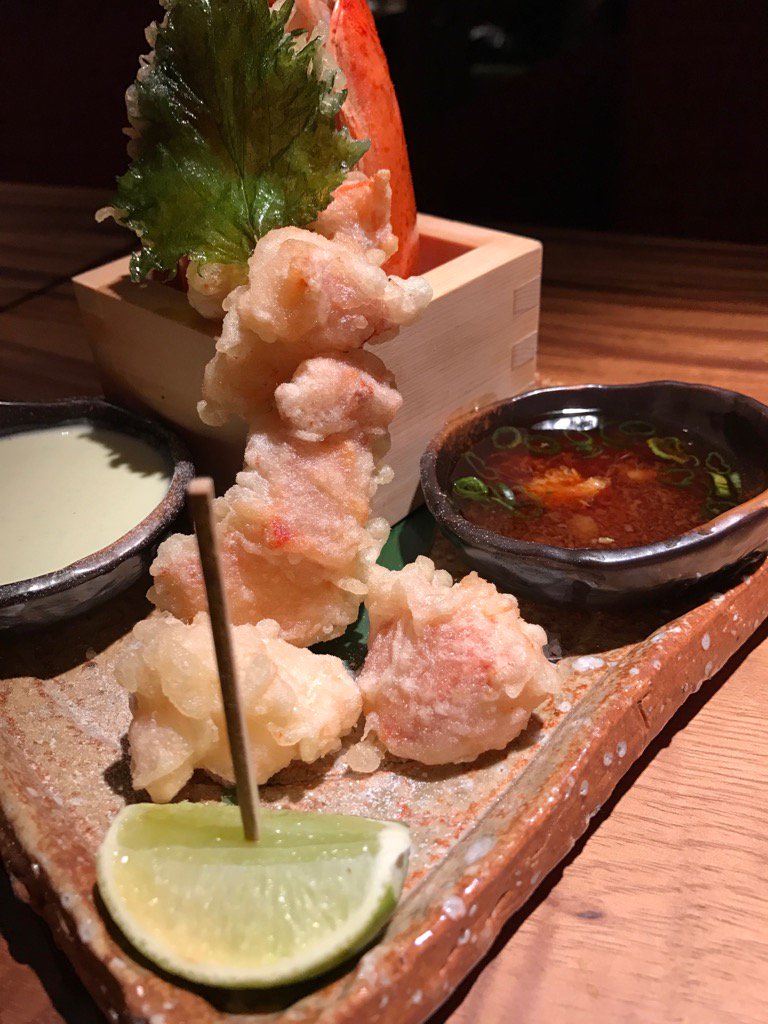
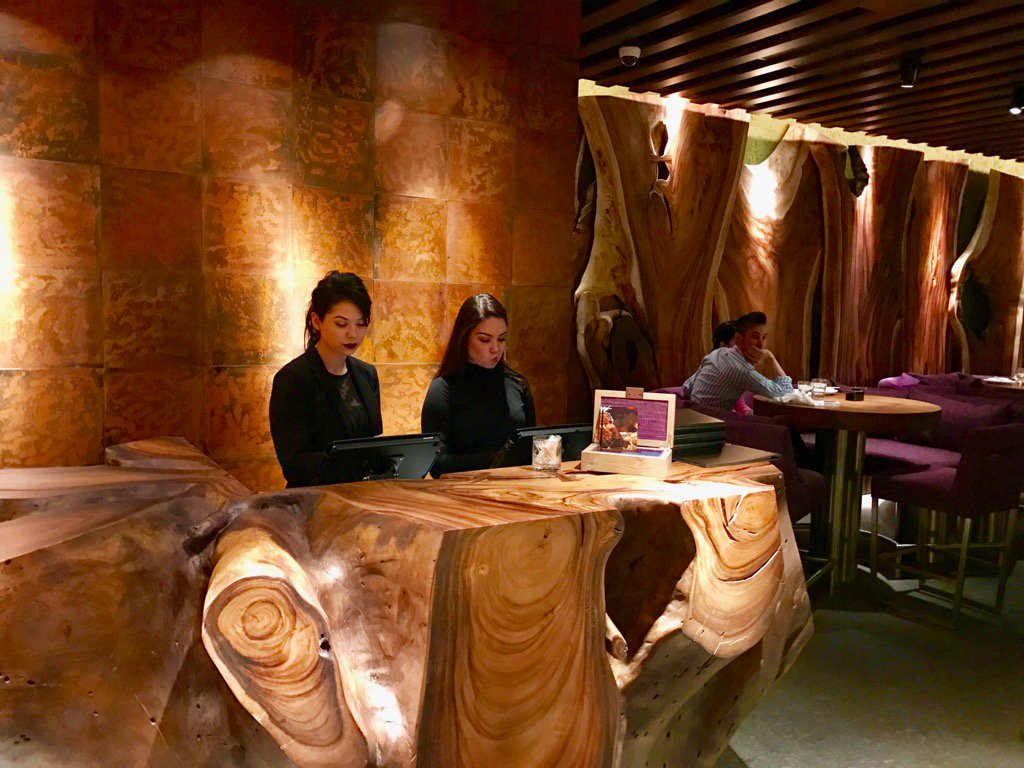
The first thing you notice about Zuma is the wood. There is lots of wood. Wooden hostess desk, wooden tables, wooden bars, wooden everything. We’re talking whole trees here, not some namby-pamby sliced logs:

ZUMA

The Cosmopolitan Hotel and Casino

3708 Las Vegas Blvd. South

Las Vegas, NV 89109

702.698.2199

https://www.cosmopolitanlasvegas.com/restaurants/zuma

* Which (we guess) makes Zuma the Ruth’s Chris to Nobu’s Palm, with Morimoto making himself the Morton’s of the bunch. Or something.

A Tale of Two Noodles

 It is the best of noodle times, it is a long way from the worst of noodle times. It is the season of shoyu; it is the winter of our udon contentment. In other words, if you love Asian noodles in all their forms, you should be in hog heaven these days.
As recently as seven years ago, no one in Las Vegas knew a soba from a shiso. These days, you’ll find Asians, Asian-Americans, and haolies of all stripes hunched over steaming bowls of long hand-pulled noodles, and debating the merits of mentaiko versus mian.

With the opening of Monta seven years ago, informal, Japanese eating took a giant leap forward and has never looked back. But one thing has always been missing: an udon parlor to call our own.  Thankfully, yet another Southern California import — Muragame Monzo Udon — has now planted its flag here, allowing our Chinatown to take yet another small step towards ubiquitous deliciousness.

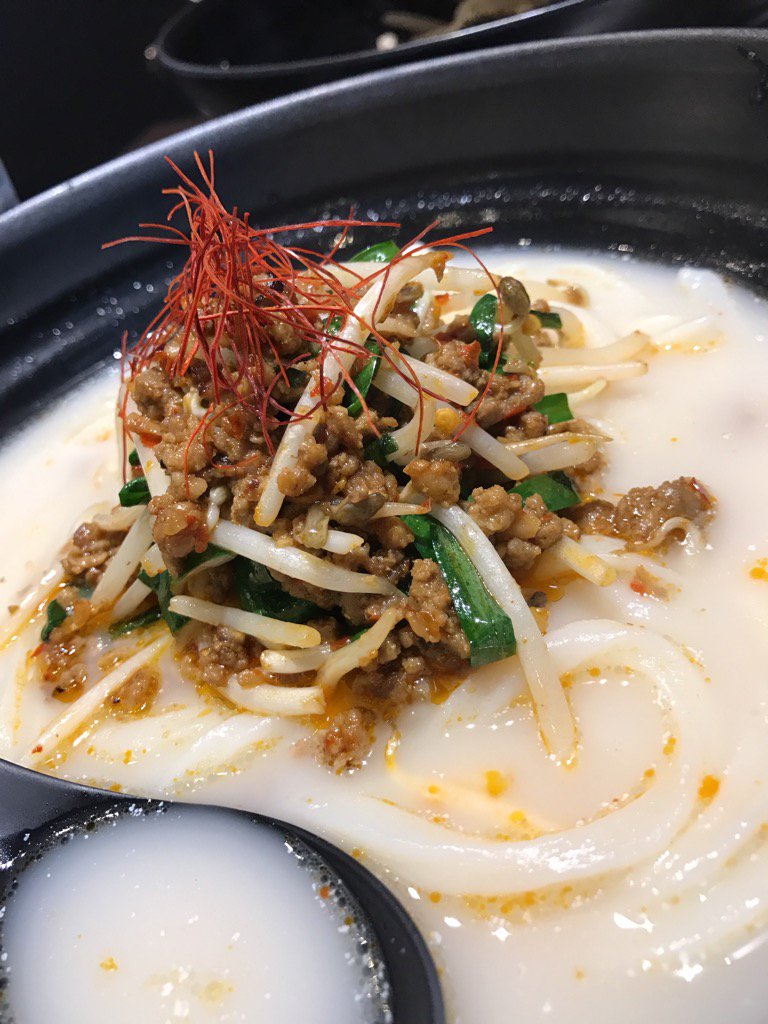
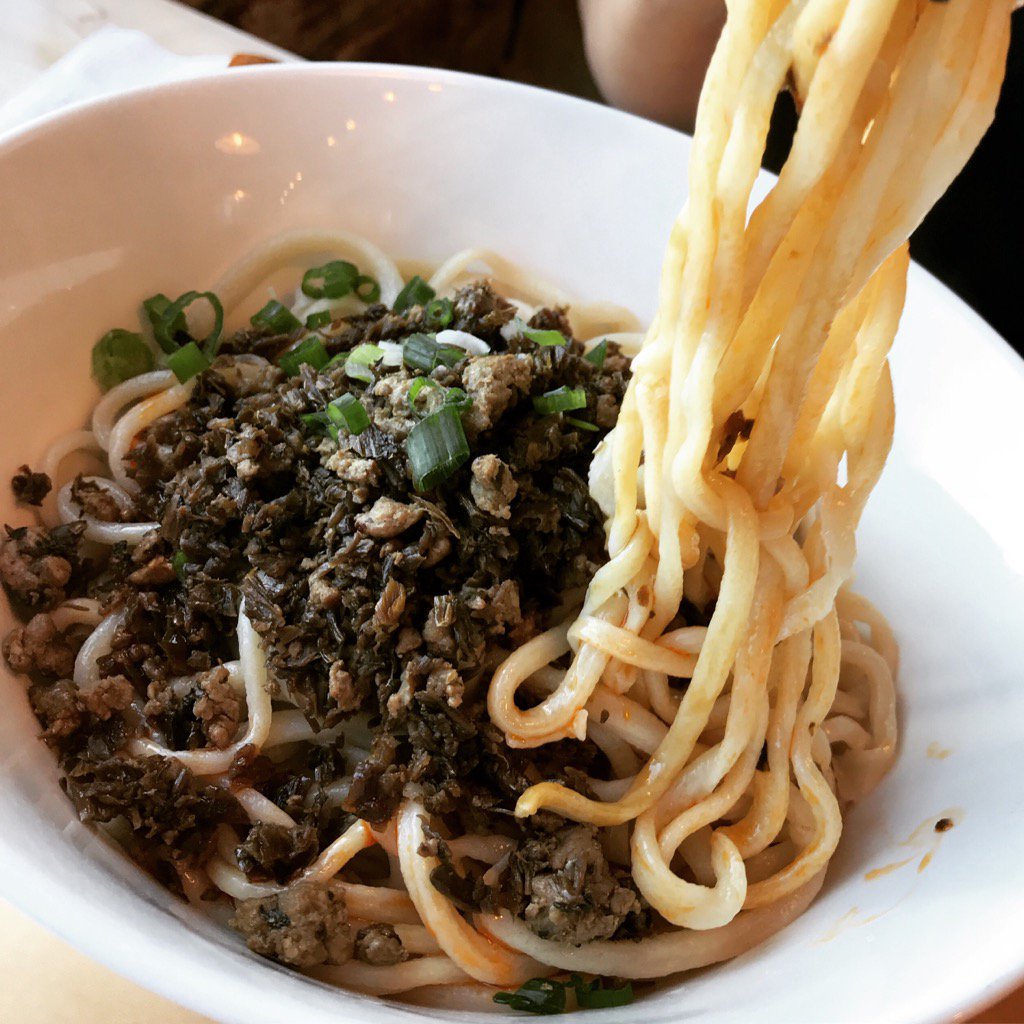
For the uninitiated, udon are thick, white, long strands of wheat starch. These are not noodles to be contemplated; these are carriers for a variety of sauces and toppings, adornments that Monzo delivers in spades. To taste them in their purest form, try them cold (bukkake* style) doused with a clear, intense broth. Of the “signature udon” that we tried, the Food Gal® is partial to the Mentai Squid Butter (flecked with crunchy fish roe and bits of squid), while I found no fault with the Hot Dragon Udon (pictured above) — it being dressed with lots of spicy ground pork and Chinese chives. Some people are fond of the Miso Carbonara and Sea Urchin Cream versions featured here, but to my mind, these overwhelm the chewy, wheat-i-ness of the noodle, and thereby miss the point.

Image may contain: 1 person, indoor

Not to be outdone, Shang Artisan Noodle (pictured above) brings a Chinese spin (and that wonderful, hand-tossed lamian) to west Flamingo Road. I’ve always considered the way they can pull and toss and stretch a huge wad of dough into individual strands of noodles to be an ancient form of Chinese magic. There’s also something magical about the dense, beefy broth that accompanies the Shang Beef Noodle, or the dry, spicy kick of their dan dan mian:

….  or the over-the-top chewiness of the Beef Pancake — it being more like a large, juicy, xiao long bao stuffed with a steamed, onion-flecked hamburger:

Image may contain: food

I don’t wish to start an international incident, but it’s now a dead heat as to who makes the best thick Asian noodles on earth.

MURAGAME MONZO UDON

3889 Spring Mountain Road

Las Vegas, NV 89102

702.202.1177

https://www.facebook.com/marugamemonzolv/

SHANG ARTISAN NOODLE

4983 W. Flamingo Road Ste B

Las Vegas, NV 89103

702.888.3292

https://www.facebook.com/ShangArtisanNoodle/?ref=py_c

* Do not, under any circumstances, look this up.