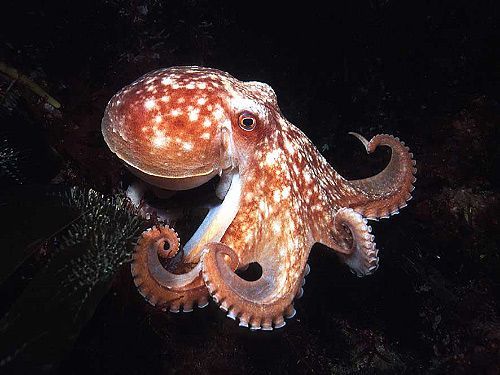
Some people like to eat octopus. Liberals mostly. – Russell Baker
Some people like to eat octopus. Liberals mostly. – Russell Baker
In case you haven’t noticed, ELV is going a little light on the posts and articles this week.
Due to some circumstances beyond his control, and some within, he has decided to take a few days off and give his brain, mouth, fingers and liver a rest.
He’s also hoping the respite might rekindle his appetites and inspiration for food writing — since nothing he’s eaten in the past year has done the trick.
You can expect regular postings commence a-new this weekend.
Best and bon appetit,
ELV
[imagebrowser id=1750]
Every food writer has their epiphanies.
The earliest ones are the most memorable, and stay seared on your brain and taste buds like they were put there with a branding iron.
There was our first taste of barbecue in the early 60s — from a place we remember as Meyer’s, or Meier’s or Myers in Orlando, Florida — a platter of chopped meat swimming in a sauce we thought was the best thing we had ever put in our mouth. (To this day, ELV has a weakness for even bad barbecue sauces.)
Then, in 1964, an oval, silver dish of crab meat bubbling in a sherry-butter sauce at Antoine’s in New Orleans — a dish so good we remember turning to Marcella Ruth Schroader Curtas (d.o.b. 8.10.24 – The Official Mother of ELV) and asking her: “Why don’t you cook like this, Mommy?”
After that, adolescence and life interceded, and we spent our teens and twenties doing what every red-blooded male does: acting stupid over women.
By 1982 some of that was behind us, and we started concentrating on working our way through Jacques Pepin’s La Technique and La Method cookbooks, and mastering what little we could of Chinese cooking as well. Two years earlier, John Mariani had published an article in Playboy listing the 50 greatest restaurants in America, and since we were starting to accumulate a little cash, it seemed about the right time to start expanding our restaurant education.
True to form, ELV started right at the top with Le Francais – Jean Banchet‘s temple of haute cuisine right outside of Chicago.
Memories are dim of what we had — a bisque was certainly involved, as were sweetbreads, and probably lobster ravioli — but what we remember most is how gracious the staff was to a foursome of dining-out neophytes, how intense the flavors were, and how the whole meal cost $336 for four — an astronomical sum to us in those days.
Somewhere in his boxes of memorabila, ELV has the American Express receipt for the meal…but the sum of the experience needed nothing but a view of this matchbook to bring them all back to us.
The matchbook, you see, was given to us by foodie friend Rod Schiffman, when he was in town last week. Over a tasty lunch at China Poblano, he told us he had read an old post of ours mentioning our seminal Le Francais experience, and it seems he had a very similar one in the exact same year. Rooting around his extensive match book collection, he found the above souvenir and presented it to as a gift and a symbol of how the gourmands of our generation all started (literally and figuratively) from the same place: being taken by the hand by the French masters and shown what superior cooking is all about.
Who knows? We could’ve been there in the same week! It doesn’t matter. What matters is how important it is in a gourmet’s education to experience the best of everything as soon as you can….and how glassy-eyed we both got just thinking about a single meal, in a long gone restaurant, three decades ago.
Merci beaucoup Rod.
And merci beaucoup Mon. Banchet.
