Texas ‘Cue Quest – Part 1

Never cared much for Texas. Never will. Too many cowboys, too many myths, too many guns and too much country music. Too many Republicans, too.

The weather ain’t all that great either. If the floods don’t get ya, the humidity will. The eastern part of the state is as damp as a sweatback hog on a July afternoon, and the western hills are drier than a Comanche’s sense of humor.

Whatever you expect the weather to be, it’s not. You want cool, football weather in the fall? Try enjoying yourself in 90 degree sunshine while watching the Aggies slug it out with the East Jesus State Teachers College in a 67-0 nailbiter. Want some warmth in  early Summer? Good luck with that. I once froze my windblown ass off in El Paso….in June.

I also spent the longest summer of my life one week in Houston — where I sweated through seven days of clothing in three, while taking at least that many daily showers. (Houston is the only city in America where you can walk out the front door, shaved, showered and crisply attired, and still feel like you need to wash up (and change clothes) again AFTER SIMPLY WALKING TO YOUR CAR!

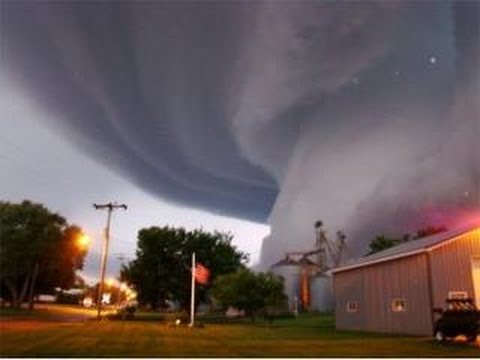
Texas is also one the few states in America that gets both hurricanes AND tornadoes. Big ones. I rest my case.

Yep, pardner, there’s a lot to dislike about Texas. Everything is bigger there, including their egos and their disasters…but they sure can rustle up a plate of good grub.

From the tacos of El Paso to enormous steaks of Armarillo to the fried shrimp of Galveston, Texans know how to eat. San Antonio pretty much invented the Tex-Mex cuisine that conquered America, and Dallas is no slouch either when it comes to everything from steakhouses to sophisticated dining. Their state beer (the “I can’t believe it isn’t water” Lone Star) may be crap in a can, but Shiner Bock is the real deal. Amazingly, there’s also a budding wine industry here, and it’s getting good reviews!

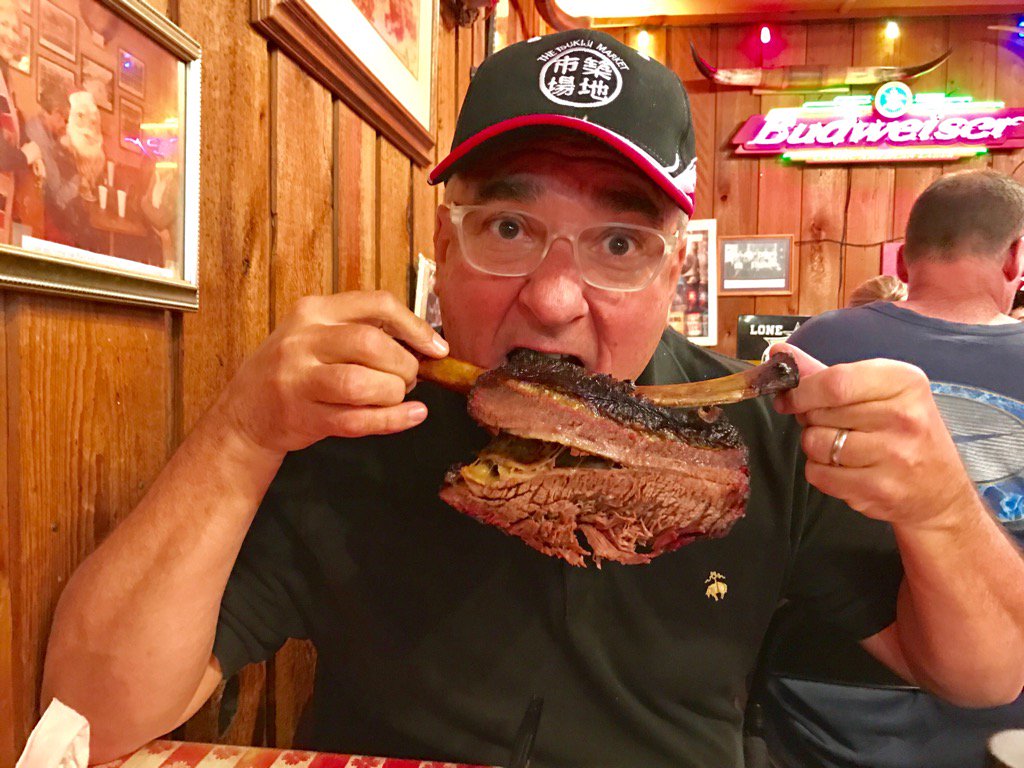
Steaks, wine, sophistication, it’s all good (or getting better) in the Lone Star State, but what Texas is most famous for is barbecue. Barbecue beef brisket to be precise, and big, thick, natural-casing beef sausages (usually containing some pork) to be even more precise. They also do a fair amount of slow-cooked pig as well (that we’ll get to that in parts 2 & 3), but beef is king here, and the brisket is legendary, so off to Austin we were.

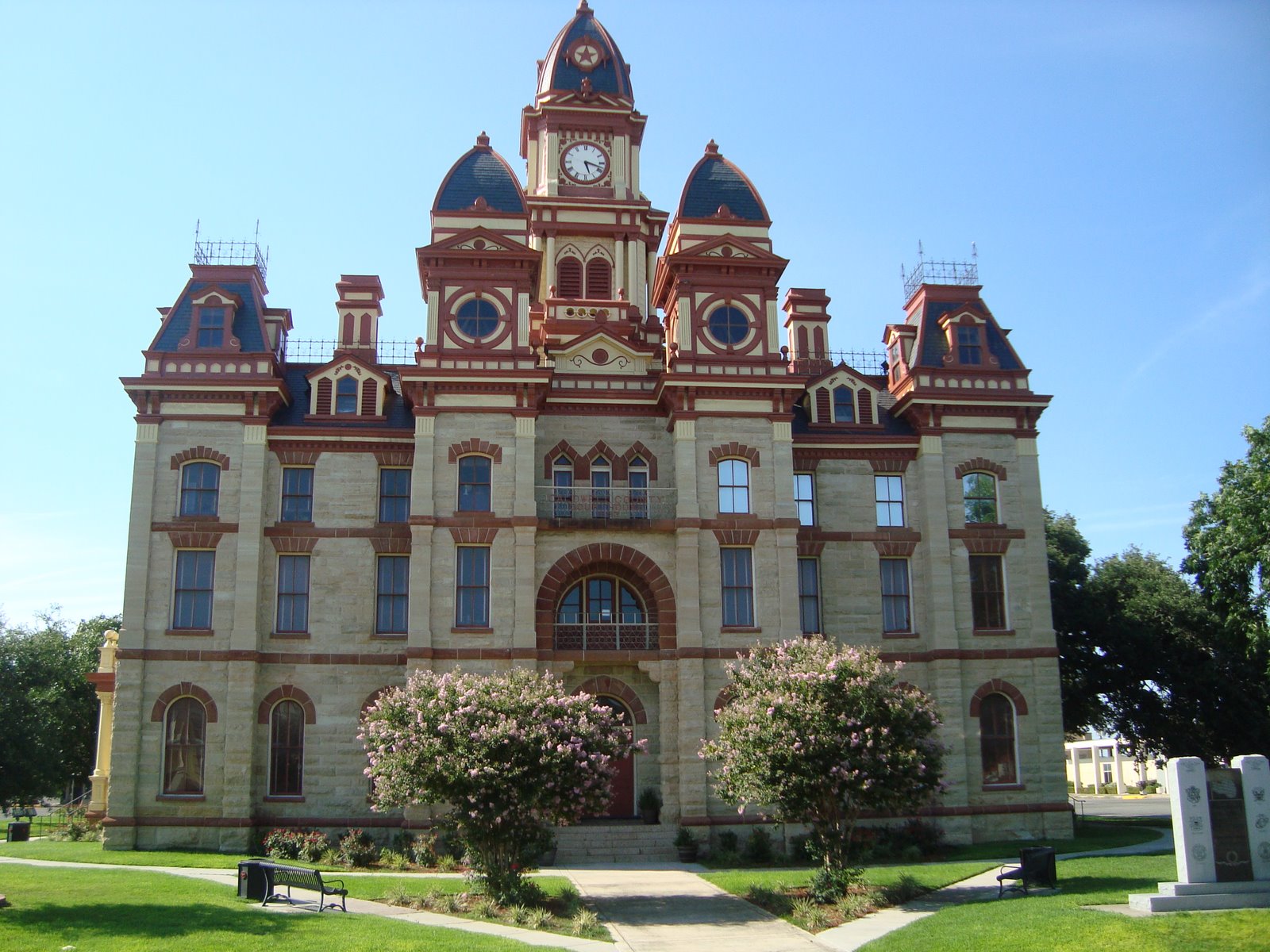
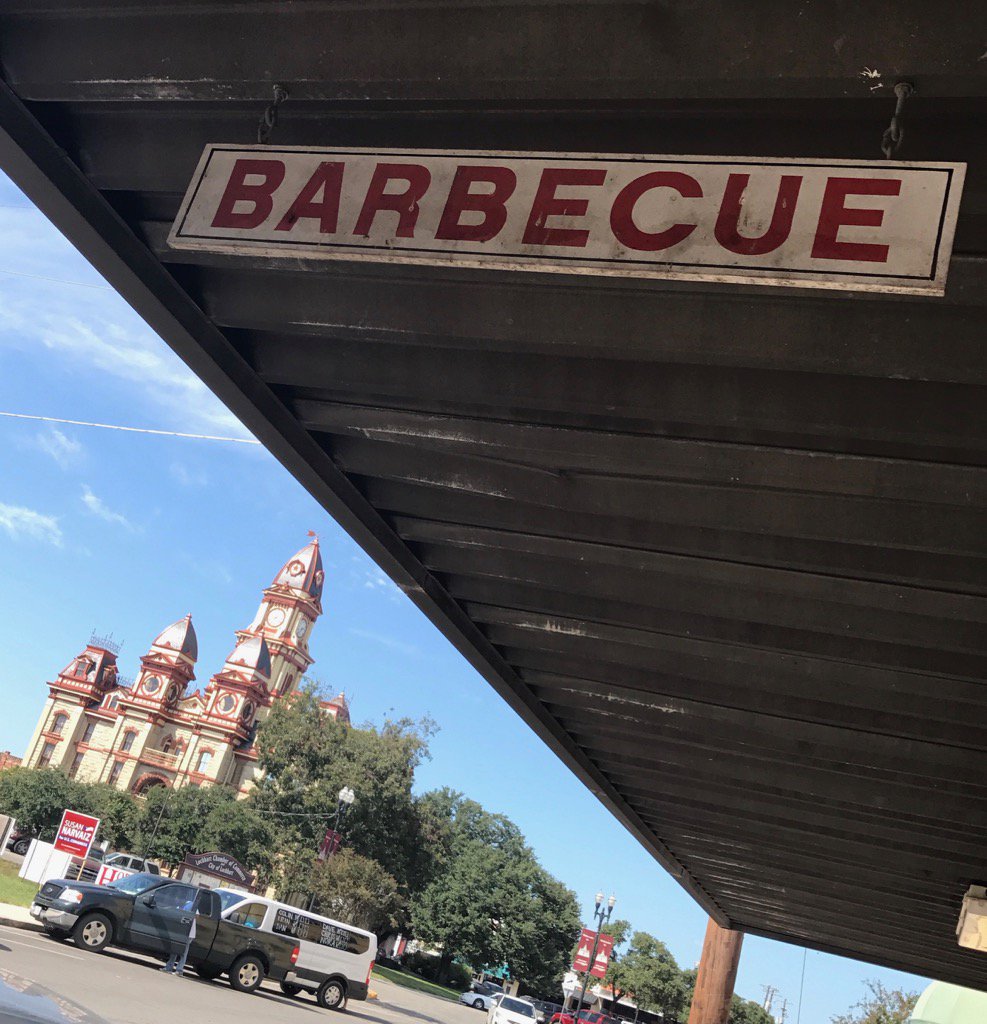
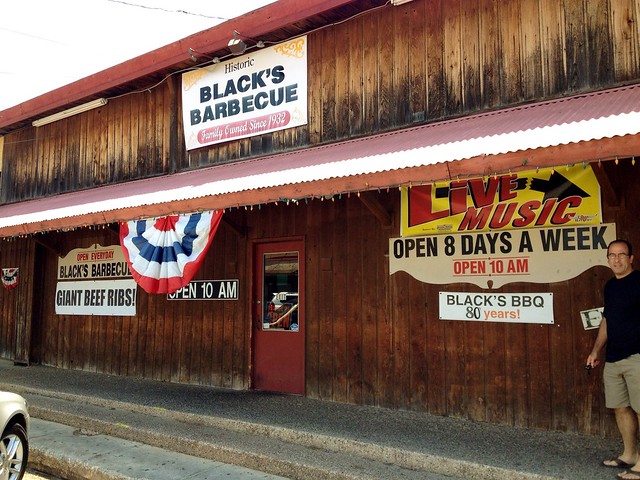
Our plan was simple: land, rent a car, head to Lockhart, and start eating all the smoked meat in sight. Lockhart is only a half hour drive from the Austin airport, and within an hour of touching down, we were chowing down in the Official Barbecue Capital of Texas. (pictured above)

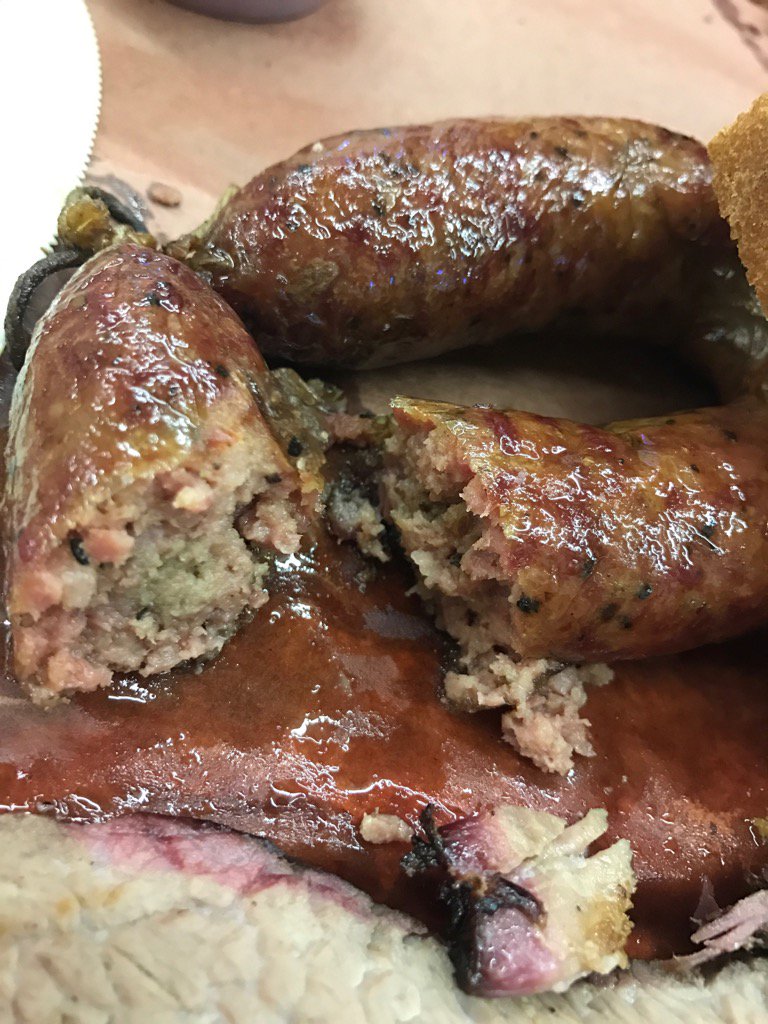
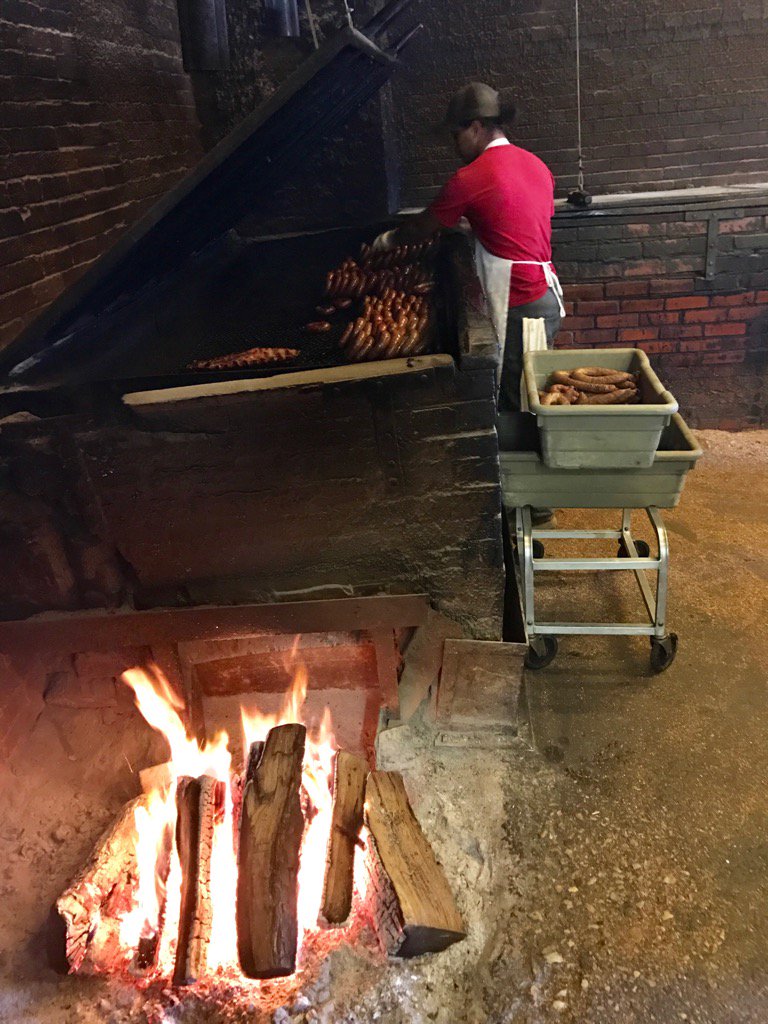
The legend goes that all of these smokehouses began as butcher shops begun by German immigrants who settled in the area back in the mid-19th Century. Sausage making is a natural by-product of cattle and pig slaughtering (and the best way to sell all of the tidbits left on the chopping block), and smoking these nasty bits was the fastest way to preserve the meat in the days before refrigeration. Then and now, these fresh-made, farm sausages are minimally seasoned and loosely packed, sometimes very loosely packed:

http://www.tmbbq.com/wp-content/uploads/2015/05/New-Sausage-13.png

…not the fine, dense samples you find in central Europe, where long curing and various spicing develops an entirely different product.

Having toured all the major barbecue micro-climates of America (the Carolinas, Georgia, Tennessee, Kansas City, Houston) over the past forty years, we were anxious to see what all of recent shouting was about. It seemed like Texas barbecue was suddenly getting more of its share of publicity, and it was more than a little puzzling how a form of cooking that is hundreds of  years old, was suddenly a “thing.”

Back in the day (and by “back in the day” I mean the 20th Century and the first ten years of this one), you went barbecue hunting with only your nose as a guide. If you were lucky you had a an address or a scrap of newspaper (or a weather-beaten magazine article) in your pocket, and the best you could hope for was to find a local and ask for directions — directions that were always of the “go down ’bout two miles an look fer the Pete’s Garage sign and take a left” variety. But mostly you just drove around until you saw the cars and smelled the smoke. Your nose told you you were pointed in the right direction, and the cars (always a mix of everything from beat-up pickups to brand new Mercedes), let you know you’d found the real deal.

Then, as Texas Monthly has noted, a “tectonic shift” in barbecue occurred — a shift, it should be noted, that coincided with the rise of social media and the economic recession. Seismic events that led to everyone seeking out cheaper eats, and lots of out-of-work young chefs to look for inexpensive ways to feed them.  These days, everyone’s an expert. Google “Texas barbecue” and get ready for an information overload. There are barbecue trail maps, learned academic essays, and more blogs than you can shake a hickory stick at.

Part of this can be ascribed to the rise of Facebook, Instagram and Twitter, and part of it is what I call the “ramen renaissance” in vox populi punditry. Put them together and you have a vortex of strongly-held opinions, based upon cheap food that can be consumed willy-nilly, and then critiqued with all of the imperiousness of a true connoisseur. Thus, in the last five years have we seen the hoi polloi expounding on everything from tonkotsu ramen to cupcakes. For the price of a plate lunch ($10-$20) you can do the same with brisket, ribs and sausages to your heart’s content. And sometimes, it seems, that’s what everyone in Texas has done.

But we wanted to dive a little deeper, to use the current cliche, and see what makes this old-fashioned cuisine so popular, and of-the-moment. And to do that we started where it’s been going on for the longest, a quaint little town in Central Texas that fairly reeks of smoke and soot of the most delicious kind. Stay tuned this week and next for the savory details of our meat-fest in Lockhart, and our subsequent tour of four other barbecue icons — both old and new — all in and around the Texas capital.

(This is the first of a three-part article on ELV’s recent trip to Texas)


Tasting the Traube Tonbach

https://gourmoer.files.wordpress.com/2014/11/traube_tonbach_baiersbronn_15.jpg

ELV note: We know the title of this web site is “Eating Las Vegas,” but we also know that you know that we do not confine ourselves simply to the pleasures of dining in Sin City. Indeed, we travel the world, calibrating our palate to the cuisines of its greatest chefs, the better to give us (and you) a baseline from which to judge all great restaurants. Below is our love letter to the enchanting hotel we visited late last year in Germany’s Black Forest (“Schwarzwald” – pronounced SCHVARTZ-vald). We hope you get a chance to visit there someday, but even if you don’t, we hope you will take some pleasure in living vicariously through our travels, and through these words and pictures.

There’s a lot to do at the Traube Tonbach. Spas, swimming (indoors and out), skiing, hiking, exploring the picturesque valleys and towns of Baiersbronn, all await you, all while taking in some of the crispest, cleanest, pine-scented air in the world.  If you’re the shut-in type, you’ll find nothing to complain about either. The 153 rooms are enormous, the bathrooms even more so, and it seems everywhere you look (out of giant, wood-trimmed windows) you see one stunning, forest view after another.

Calling the Traube enchanting is an understatement. From the traditional Tyrolean garb of the crackerjack staff:

…..to the oversized, Black Forest decor, everything about it has a formal-yet-friendly precision that seduces you from the moment you sink into an overstuffed chair or start sipping a crisp glass of Riesling. You can be as laid back or active as you wish at the Traube Tonbach, but what you really ought to be doing is eating.

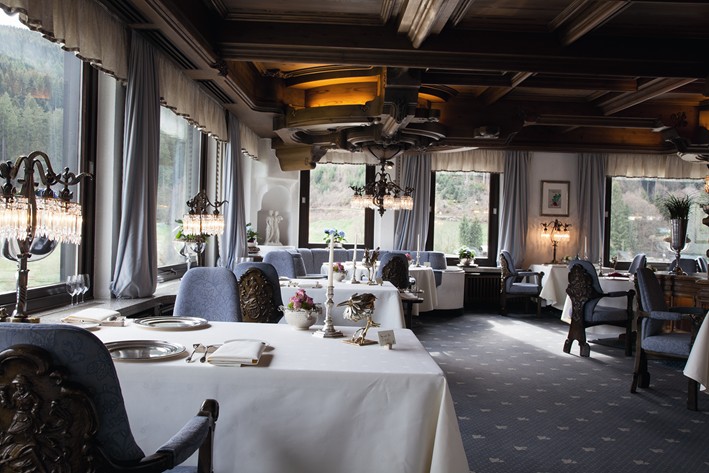
Harald Wohlfahrt’s Schwardwaldstube (pictured below) has held three Michelin stars since 1992. The name means “Black Forest Room” and the thickness of the wood, the chairs and the linens give not a clue as to the lightness and freshness of his cuisine.

room

The room only seats 40 customers, but so precise is the food, you get the feeling that there are at least that many cooks in the kitchen. Wohlfahrt told me (through an interpreter) that his cuisine has become more international over the years, and like most chefs in this league, he now plays with flavors from around the globe. Some might fault him for letting these flights of foreign fancy overtake him, such as when he accompanies beautiful poached Gillardeau oysters with ponzu jelly, shredded beetroot and horseradish, plus a chives vinaigrette, but to my mind, everything harmonized the way it’s supposed to with highfalutin fusion food. What Wohlfahrt’s elemental, not-bashful cooking told me was that I was in a bigger, bolder, German version of a French restaurant, not a dainty Gallic one.

“Not bashful” would be my same description of the Swabia-meets-Bologna construct of  Wohlfahrt’s ravioli. Stuffed with a moist, dense, “confit” of calves head, and garnished with sweetbreads, and tongue — it was elegant and earthy, not an easy feat in any language. Festooned with truffles, it was part French, part Italian, and definitely Deutsch, and genuflected to all three cuisines without surrendering to the heaviness of its pedigree.

 From there, our meal proceeded seamlessly through meaty slices of wild turbot in an intense, sea urchin nage, through local “homegrown” venison in a juniper sauce that tasted of a hunter’s bounty, if he happened to be a Michelin-adorned superstar. This is cold weather, nip-in-the-air eating at its finest, I thought to myself — food that matched the evergreen forest surroundings as much as the heavy, carved wood upon which we sat.
 As wonderful, and of-its-place as our game and fish repast was, it was my wife’s vegetarian meal where the kitchen really proved its mettle. Six courses of jaw-dropping variety that were even more stunning than the proteins — variation of carrots in a black tea emulsion, grilled pineapple and confit of fennel in a Ricard Pernod/passion fruit stock, and a potato-mushroom ravioli with caper jus and chanterelles — any and all of which could make you forget about meat altogether. This sort of high-wire, multi-dimensional, vegetarian cooking proves how exciting vegetables can be when placed in the right hands. As with my meal, every course was a show-stopper, but the highlight was an egg white souffle encasing a reinserted yolk with a white truffle sauce so intense I had to check my pulse.

About the only clinkers in the meal were the desserts, that seemed terribly overwrought — almost as if the pastry chef was trying too hard to keep up with the pirouettes taking place on the savory plates — and a serious service lapse towards the last quarter of the meal, when everything seemed to slow to a crawl. To be fair, there were several large parties in the restaurant, all of whom were spending way more money on wine than we were, so that may have backed up the kitchen. By the way, this was the third Michelin 3-star meal I’ve had in the last year — the others being at Meadowood in Napa Valley and Auberge de L’Ill in Alsace — where the highly visible and solicitous maitre’d seemed to disappear from the dining room for the second half of the meal. Perhaps this is the 21st Century job description: show up, look good, kiss hands, and then vanish. Or perhaps these impeccably groomed face men have second jobs posing in department store windows. Either way, it strikes a small, discordant note where there should be none.

As for wine, the list is extensive (750+ labels, 36,000 bottles) and shoulder deep in great German and Alsatian Rieslings.  Markups were more than fair — especially compared to New York and Las Vegas — with dozens of great bottles for 100 euros or less. My rule of thumb when star-grazing in Europe is to look for bottles in the 50-100 euro range, and I’m consistently amazed by the quality at those prices. I took the wine pairing with my degustation, and it, along with our young sommelier (who didn’t disappear from the room) was superb.

http://www.traube-tonbach.de/media/traubetonbach/img/dyn/e70807b638e247b783f547652f4cbe94.jpg

The Schwarzwaldstube would be a fitting crescendo to anyone’s visit to the Traube, but we worked in reverse order for our two day stay. Dinner number two found us again across the street from the main hotel (at the original, heavily timbered inn that now houses the “Black Forest Room,” an international restaurant (that we didn’t try), and a traditional restaurant (the Bauernstube) that we did. Those timbers, low ceilings, plaster walls and wooden benches give the Bauernstube (pictured above) a distinctly 18th Century feel, but this being the Traube, the linens are as thick and crisp, and the table ware every bit as formidable (if several clicks more casual) than at its starred sister restaurant down the hall. They share the same wine list, and the food is every bit as satisfying and rib-sticking as you would expect southwestern German food to be.

Being strangers to Swabian cuisine, we didn’t know what to expect, although we suspected that the six mile hike we took earlier in the day was probably a good idea. As with every German restaurant, the difficulties of the language are always looming to surprise you with a disconnect between what was described, what you thought you ordered, and what shows up. For example: three, fist-sized stuffed ravioli are described as a “snack” on the menu, but what appears could fill up a sumo wrestler.

(In a similar vein, a chef once told us he mistakenly ordered a plate of butter as an appetizer in a German restaurant.)

Undaunted by our “snack,” we sallied forth with the rest of our meal and found everything to be as enjoyable as a meal of golf ball-size sweetbreads (used to “garnish” a perfect blanquette de veau, no less), tennis-ball sized liver dumplings, football-sized noodles, and brook trout can be. The trout tasted as if it had jumped right from the stream onto our plate (because it almost did, we were told), and, filling or not, those dumplings, veal and sweetbreads are two dishes I’m still dreaming about.


My parents told me decades ago about the wonders of German breakfast buffets in upscale hotels, but it wasn’t until I forced myself into an early awakening on my second morning here that I saw what they were talking about.

https://media.hotelwebservice.com/media/traubetonbach/img/dyn/dfafc065c2ac482cab443ed000f17e9d.jpg

“Get here early,” one of the staff told me, and so I did, bleary-eyed and still wrestling with my weightlifter’s repast of the night before.

What I confronted was more temptation than any one man should face while he’s still digesting Swabian dumplings: Every bread and pastry imaginable, right out of the oven. Miles of meats, cheeses, fruits, jams, and jellies. Scores of butters and spreads. Eight kinds of milk. A dozen fresh-squeezed juices. Every kind of smoked fish you’ve ever heard of and more sausages than you can shake a stick at. Carved beef, cured ham (four kinds!), smoked ham, eggs out the wazoo and half a dozen local honeys. Aged fromage from all over Europe, and did I mention the pastries and meats?


And the wurst was yet to come!

 Forgive me, but I’ve waited twenty years to use that joke in a food article, so you’re stuck with it.

Everything from the coffee to the head cheese was exemplary, and the finest of its kind of any buffet I’ve ever been to. It was so good it restored my faith in overeating.

My parents were right: The Germans do breakfast better than anyone. Their hotels and 3-star restaurants concede nothing to the French, either, with everything correct down to the last detail. Michelin is right too: this magical place is definitely worth a special journey.

Our dinner for (two tasting menus + one wine pairing) at the Schwarzwaldstube came to 461 euros including a generous tip. (Yes, they tip in Germany, usually around 10%.) The Bauernstube dinner was 108 euros, and I don’t remember what the breakfast buffet cost, but it’s worth anything they want to charge for it.


HOTEL TRAUBE TONBACH since 1789 – Familie Finkbeiner KG
72270 Baiersbronn im Schwarzwald, Germany, Telephone +49 (0) 74 42/4 92-0, Reservations +49 (0) 74 42/4 92-6 22
Fax +49 (0) 74 42/4 92-6 92, reservations@traube-tonbach.de, info@traube-tonbach.de
Facebook Hotel Traube Tonbach – Baiersbronn

Aging Beef Gracefully – THE STEAKHOUSE and CHARLIE PALMER

 To be fair, it comes with a potato (how retro!), and some very good vegetables, or an extremely good black bean soup — that soup comes with a jigger of sherry, just as it should. But what really set off the meal for us was the pitch perfect wedge of lettuce with bacon and blue cheese:
.

We opted for the dry-aged strip (with a little Kagoshima A-5 thrown in for good measure) and both cuts were the equal of anything in town. The basil ravioli with guanciale and chanterelles was no slouch either, and would’ve been right at home at B&B Ristorante. It, along with that superb spinach salad, had me and the Food Gal® fighting for the last bite.

But what really floated our boat (as it was clogging our arteries) was the duo of foie gras: