A Moveable Feast – How to Eat and Drink in France and Italy

Good food is everywhere in Europe, at all price points these days, so there’s no excuse for not eating well when you’re over there.

The three countries I visit most (Italy, France, Germany) have serious coffee cultures, so a good cup of joe is always within reach. Those ubiquitous cafes and coffee bars also stock plenty of other juices, teas, and alcohol….so if you’d like some Jack Daniels or Amaretto in your cup at 8 am, they’ll oblige.

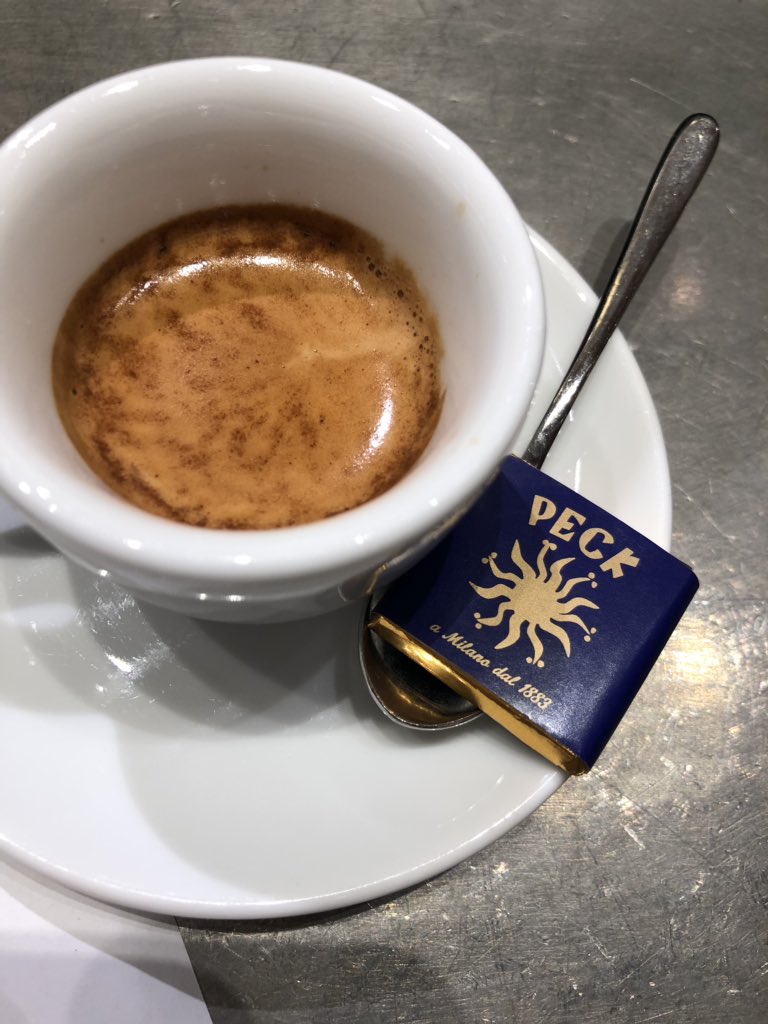
I’m not going to get into all the fine points of Euro coffee cups, but the  big difference between their coffee cultures and ours has to do with volume, strength, and frequency. Euros take their coffee in small, strong doses, and do shots of it throughout the day as caffeinated fuel. If you can’t handle the high octane stuff (aka espresso), ask for yours au lait (“with milk”) or café crème (France) or con crema (Italy). Crème and crema both mean “with cream”, although it’s really more like whole milk.

Confused? Don’t be. Just do what I do: either order a cappuccino or just say olé!

My routine is: find a cafe close to your hotel, adopt it as your hangout for how many days you’ll be in town. By day two or three the proprietor/barista will treat you like an old friend when you walk in. Unless you’re in Germany. In Germany, they don’t even treat old friends like old friends.

For the record, here’s my 12 Step Program for eating in France and Italy:

  1. Wake up.
  2. Shower, shave, take care of business while trying not to twist, strain, or break anything in the process (see previous article).
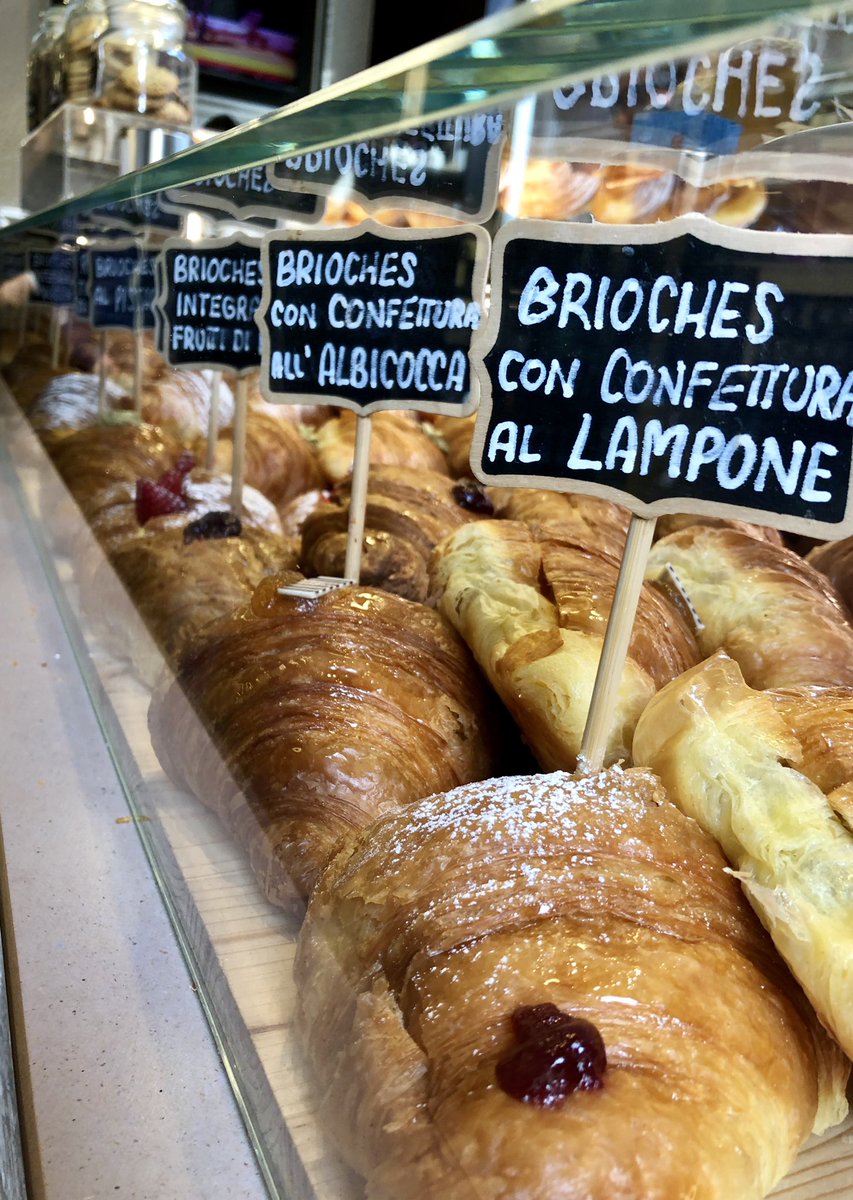
  3. Go to your regular cafe and get a cafe au lait with a croissant (France), or a cappuccino with a brioche (Italy). Gently caress the pastry in one hand as you dunk it into the soothing brown liquid, then eat it while sipping and holding your cup in your other hand. Perfect this art and you’ll feel like a native in no time. Perfect it whilst standing up and affecting a vague air of insouciance about world affairs, and the women will flock to you like you’re Marcello Mastroianni in 1962.
  4. Remember, in France and Italy, breakfast is good for only one thing: thinking about lunch.
  5. Start thinking about lunch
  6. Eat lunch (see below).
  7. Towards the end of lunch, start discussing your dinner plans.
  8. Rest up for dinner.
  9. Have dinner.
  10. Walk off dinner for an hour or so, promising your wife you’ll take her shopping or sightseeing in the morning (which you both know is a lie).
  11. Return to hotel.
  12. Sleep, then repeat steps 1-12 the next day.

Lunch

(Dejeuner at Le Grand Véfour)
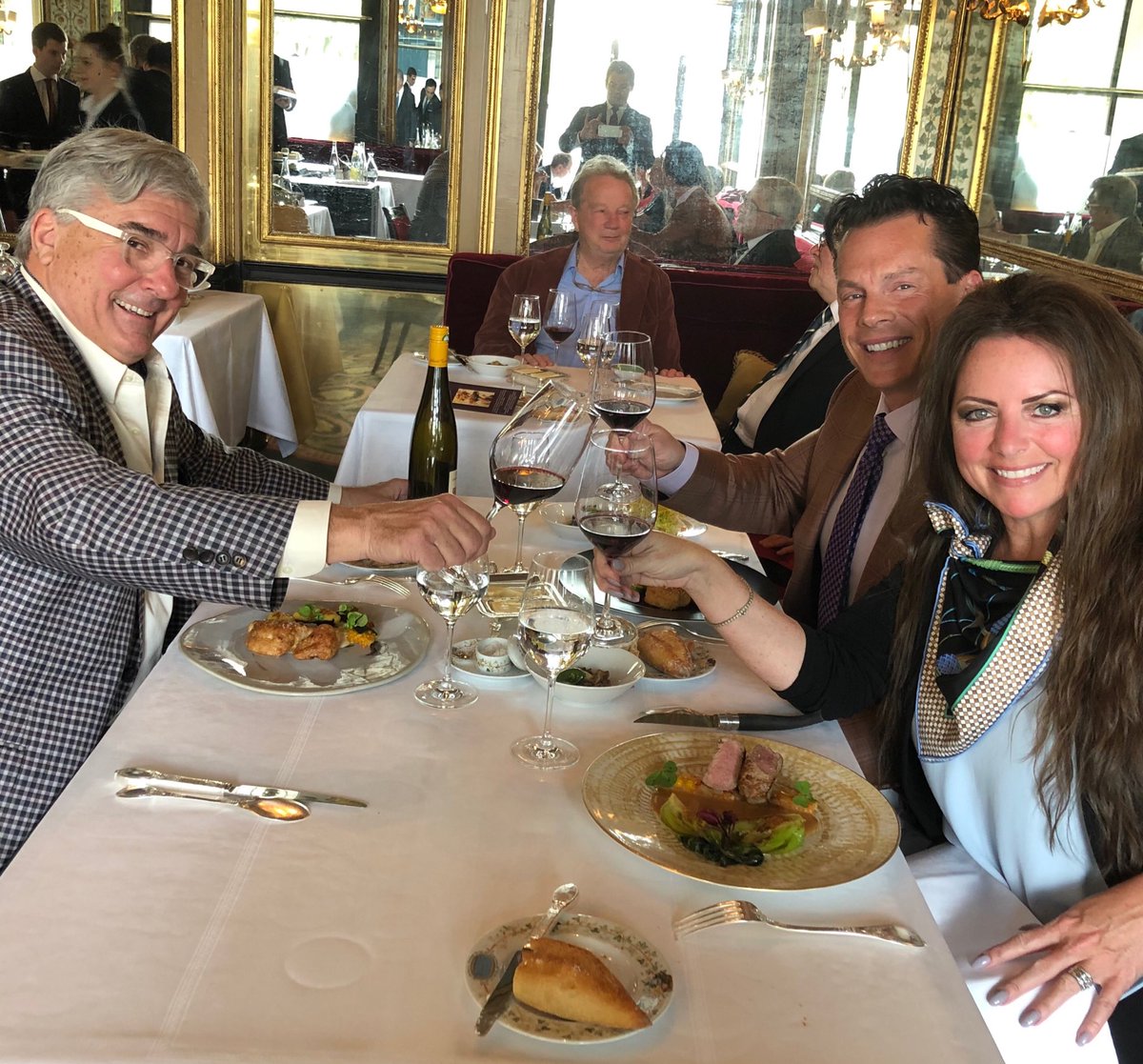
The older I get, the more I like to eat and drink myself silly at lunch rather than dinner — it gives you more time to digest things and walk off the calories.

Americans aren’t used to intensive care service at high noon, but it’s the best way to enjoy a big deal meal at a destination restaurant. There’s usually a “lunch special” of a few courses for a set price that’s a relative bargain, and the difference between the food at lunch and dinner is nil. In fact, to my observation, lunch is when most the local gourmets come out to play in the big cities. Dinnertime seems to be for businessmen and tourists.

Lunch takes one of three forms: either a formal affair in a restaurant (France) or ristorante (Italy), or a more casual, but still coursed-out meal in a bistro or trattoria, or a quick bite in one of those cafes where you grab your coffee (all of them usually serve some kinds of pizzas, salads, and sandwiches).

The Rick Steves of the world (and many tourists) prefer the quick casual lunch because it leaves them more time for sightseeing. In my world, the food is the sight to see, so I prefer the bistros of Paris, or a local trattoria which serves the traditional cuisine of the area. Regardless of your mood, there’s always fascinating sustenance to find.

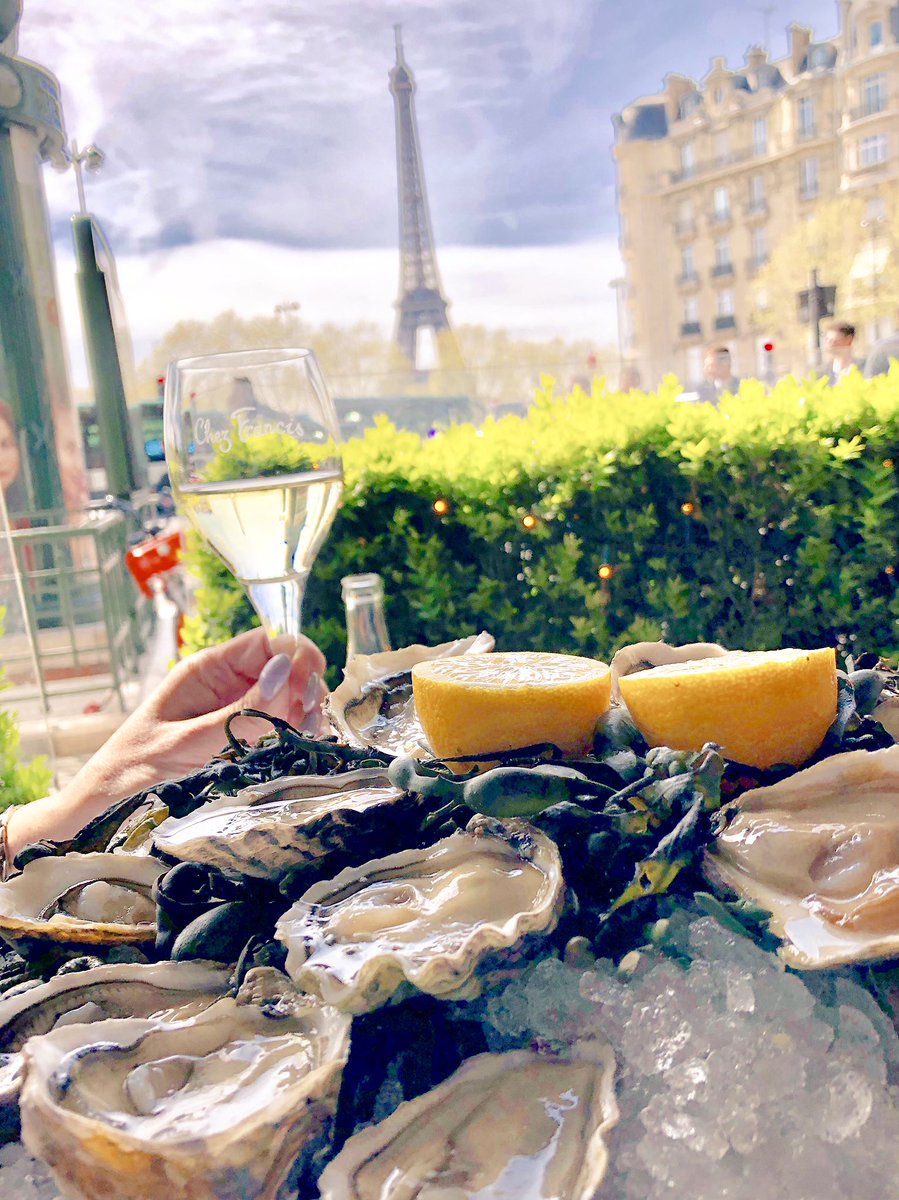
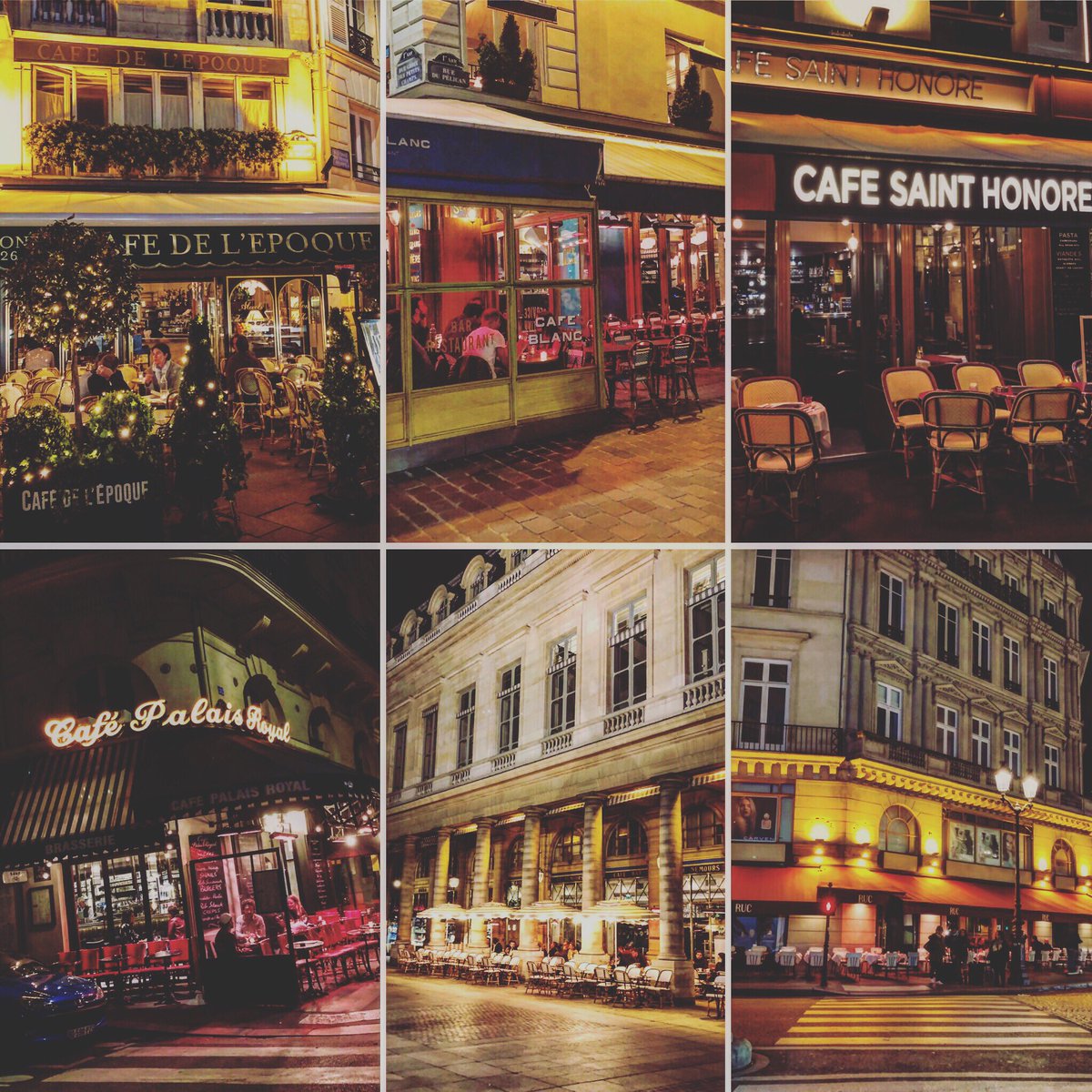
Cafes are everywhere in Paris (I counted nine in a five block walk to my hotel, above), and Rome, Milan, Venice, Verona, Bardolino (not to mention Lyon and smaller French towns like Beaune, and the entirety of Alsace) are chock full of places to eat. You may get an indifferent meal in some of them, but even average Italian or French food over there is a lot better than what we’re subjected to over here.

Dinner

Dinner should be the opposite of lunch. If you stuff yourself silly at midday, find a cafe or casual spot and while away the evening over one or two courses while pondering where to eat the next day. Wine bars are also great for small snacks and light meals.

Know, however, that more formal restaurants have fairly strict and limited service hours. Lunch is usually served from 12:30-2:30, and dinner from 7-9. Restaurants that take reservations usually have one seating only, and the table is yours until they close up shop.

Cafes, bistros, brasseries and trattorias are much more flexible and generally have non-stop service throughout the day….although the only people you’ll see chowing down on a pizza or choucroute garni at 5:00 pm are usually jet-lagged tourists. A good rule of thumb is: the more limited a place’s hours, the more serious it is about its food. Speaking of which…

Rules of Thumb

No photo description available.

Get the specials. If there’s a chalk board (and in France, there’s always a chalk board), order off it. That’s where the good stuff is.

Get out of your comfort zone AKA take the stick out of your ass. You didn’t come to Europe to eat a burger anymore than you would come to America to view ancient ruins. European menus are full of wonders, but you have to bring an adventuresome spirit to the table.

Europeans are closer to their food than we are. Literally. They eat and drink products that are grown or manufactured where they live, not a thousand miles away. And you can taste the difference. Plus, all of the dishes we take for granted over here (pizza, Béarnaise sauce, oeufs Romagna avec sauce Espagnole a pigeoneaux Romanoff jubilee) had their origins over there, and tasting the real enchilada where it was invented cannot be overstated as an epicurean experience.

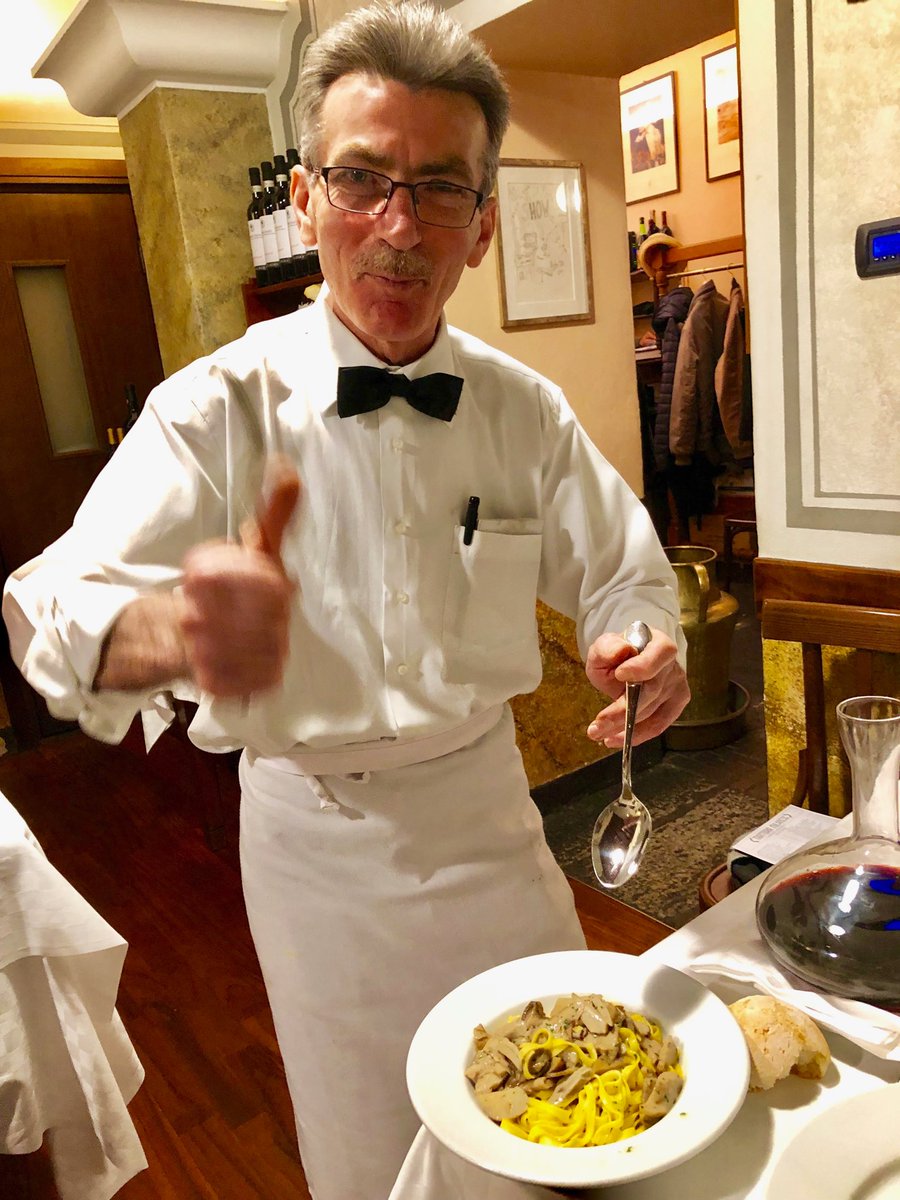
Don’t be intimidated. English is spoken all over Europe these days — it’s a mandatory subject for schoolchildren — and between the English language menus and helpful waiters, you’ll rarely be at a loss for words, or some tasty morsel. The spry fellow we had at Trattoria Milanese (above) spoke better English than my Greek popou, and the waiter we had at our best bistro meal in Paris (at La Bourse et la Vie) was a bi-lingual chap from New Jersey.

Forget about cocktails. With a few exceptions (e.g. The Jerry Thomas Project in Rome, gin and tonics in Spain) cocktails are not a thing in Europe. They’ll pour you a vodka soda or expensive scotch in upscale hotels and bars (and at the corner cafe), but hard booze is to grape-centric Europe what digestivos are to the new world: not indigenous to the culture and something they struggle to understand.

Image may contain: 5 people

If you don’t know anything about wine, get the house wine by the glass or carafe. Societies steeped in wine culture don’t wallow in cheap, disgusting wine. (They blend, bottle and bequeath their plonk to us.)   Even the worst tourist traps in Rome and Paris serve decent stuff. All you have to know are the words for red (rouge or rosso), white (blanc or bianco) or pink (rosé) to drink fairly well.

If you know a little or a lot about wine, grab the list and go nuts. Bottles that go for hundreds over here can be had for 50 euros over there. My budget is usually in the 80-100 euro range, and invariably, a waiter or somm will look at my selection, and then point me to something just as good for half the price. On my recent trip, this happened on five consecutive days in Milan (Trattoria Milanese), Paris (Willi’s Wine Bar, Le Grand Véfour, Les Climats), and Verona (Pane e Vino).

Plan, plan, plan or just wing it. There are two ways to eat and drink your way around France and Italy: book everything in advance, or just walk around and see what looks good. I’ve done both and rarely been disappointed.

A compromise procedure involves doing your homework and making a list of addresses that sound interesting….and then cruising by to check them out. Only at the hoity-est of the toity will turn you away without a reservation.

Youngsters like to book everything through mobile app services (Michelin, La Fourchette, etc.), but many charming, out-of-the-way joints don’t subscribe to reservation services, and you’ll miss a lot of local flavor if you keep you nose in your phone and rely on your apps for everything.

I could go on and on. It’s been said that traveling is living intensified (actually, I think Rick Steves said that), and if it’s true, then traveling is eating intensified times ten. When you’re in a strange place known for its gastronomy, the flavors come into focus, aromas are sharper, textures linger, and the sensations are more vivid. Not for nothing do people fall in love over a bottle of wine on the Amalfi Coast, or re-evaluate the world’s beauty from their perch in a Parisian cafe. To paraphrase Hemingway: Europe is a moveable feast, and if you’re lucky enough to travel there, it will stay with you for the rest of your life.


NOMAD – The Restaurant

The first test of a restaurant is, does it make you want to return?

if you think about it, nothing else really matters,  Fine points about the done-ness of your steak or the freshness of your veggies pale before the only issue that counts: Will you come back for another meal?

Consider the following. When you’re in the middle of your first meal at a restaurant, do you:

> Gaze longingly at the dishes being served all around you?

> Think about what you didn’t order WHILE YOU’RE EATING?

> Contemplate your next meal there… in the middle of this one?

> Think to yourself, “I can’t wait to come back”?

if you answered yes to any of these questions, then the restaurant has done its job.

Whether a taco truck, a fast food joint, or haute cuisine palace, getting you back in the door is every restaurant’s first mission….and woe to the place where a customer walks out thinking, “been there, done that.”

Getting you there the first time is the product of hype, word-of-mouth, or whatever. That’s easy. Getting you to return is the hard part.

Getting people to come to The NoMad Restaurant won’t be an issue, given the name, its reputation, and the marketing muscle of MGM.

Getting locals in the door might be a different story. Getting me to come back is going to be even harder.

More on that later, but first let’s review a few things before I get to the food, because several things about NoMad, besides the food, require a reminder.

NoMad is corporate to the core. It is all calculation and concept, conceived solely to cash in on the fame chef Daniel Humm (pronounced Hūme) — fame that was achieved (with the help of some big money investors) at Eleven Madison Park. (For those who don’t hunt big restaurant game as an avocation, EMP is the mega-expensive, impossible-to-get-into, multi-course, World’s Best blah blah blah restaurant that Humm has helmed since 2011.)

As Adam Platt so deftly described, the trouble with having the world’s best anything is plenty of suitors are going to show up at your door enticing you with ideas on ways to “expand your brand,” and make a boatload of cash while doing so. In the case of Humm and partner Will Guidara, that meant springing into hotel/restaurant mode in 2012, and then planning to conquer the world by taking their expandable concept to places like London and Las Vegas.

Apparently, the only thing holding them back these days is where to find enough old books to stock the shelves. Books, you see, being the leitmotif of this place. Oh the irony, I’m sure you’re thinking, stocking a fake library with real books to surround a generation of diners who don’t read them. True enough, but the effect is stunning just the same.

The place is huge (200+ seats) but also dark and clubby  — quite the design feat, again calculated to take your breath away, and it does.

Those shelves surround you from the moment you step into the huge, fancified, fake Victorian library.  20+ foot ceilings (stocked to the brim with those books) threaten to engulf you. All of this mimics the vernacular of the New York original (much as Carbone does) while inflating it, size-wise, to keep up with the conventioneers who will be descending upon it.

NoMad you see, wants it all ways. It is trying to redefine dining for the second (and soon-to-be third) decade of the 21st Century as a place devoted to classics in a casual way. Formal dining, if you will, without the folderol. By and large it succeeds in this mission, hearkening back to days of yore when gentlemen dined in style, dressed to the nines, and surrounded by literate luxury.

No one is dressing for success anymore (shame), but even in cargo shorts, you’ll find a lot to like here, once you find a table, and therein lies a tale.

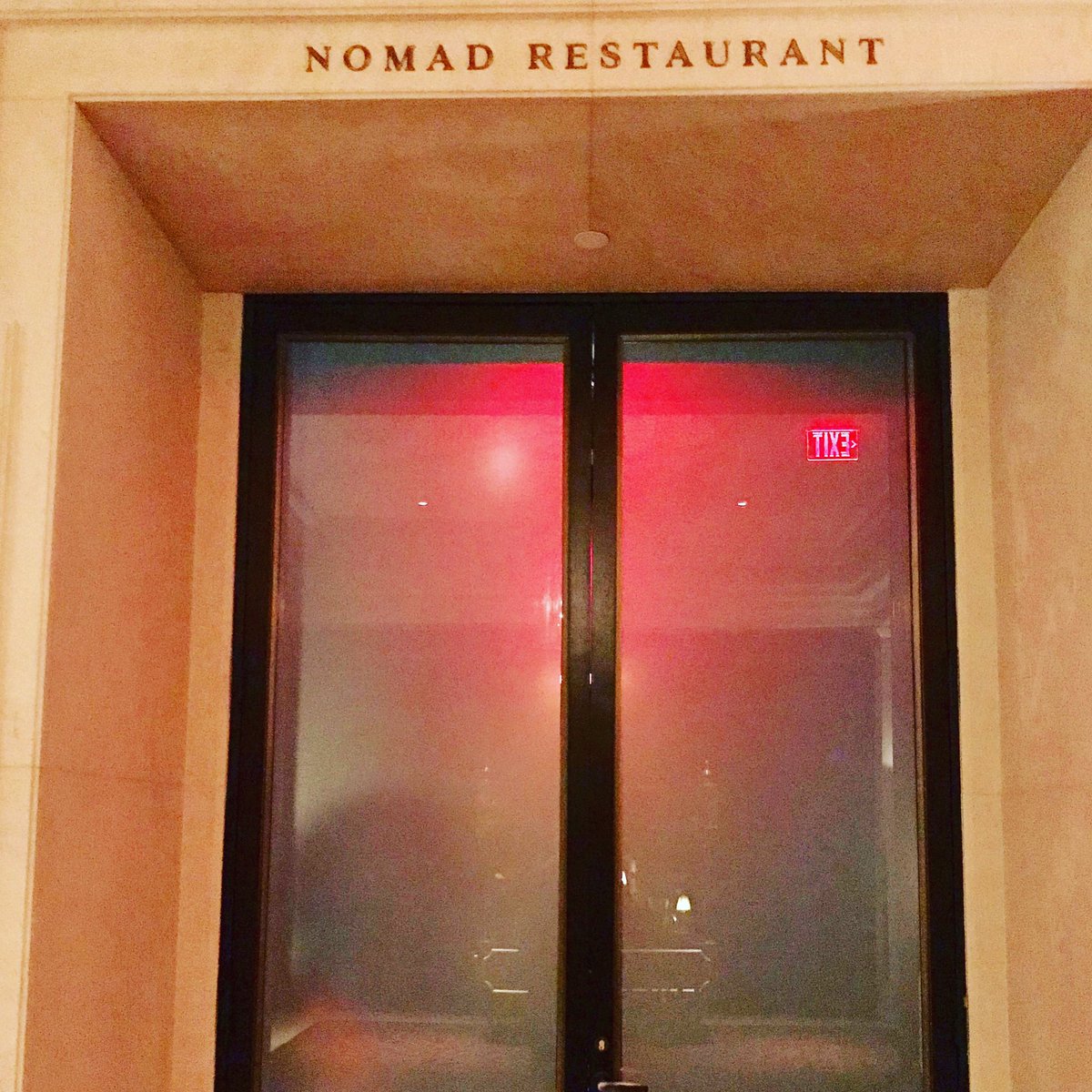
As you approach the restaurant you will see very large doors that give you a hint as to the scale of the place. Right inside those doors, to the left, is the hostess stand. That stand, on both of my visits, has been filled with drop-dead beautiful young women, none of whom seems to have a clue what they’re doing — a simple “hello, my name is ______ ” sending the bevy of them into paroxysms of wide-eyed uncertainty of the sort one usually sees at a Jimmy Choo sale.

If you want to visit the bar, you will be led through the restaurant to a long counter recessed from the main room. If you are ready for your table (after a quick cocktail), neither the hostess nor the well-meaning barkeep will know how to communicate this fact to the other, or impart the necessary information you’ll need to locate one (the hostess or your table).

Persevere and eventually someone will show up. Then, you’ll be taken back to the hostess stand (not a small hike), from which another bewildered lass will lead you to your seats. It’s all quite the production, necessitated by the demands of a (relatively) small-bore, big city eatery deciding it wants to increase its volume and siphon off some Vegas cash.

Humm and company started raking in their dough six years ago with a something-for-everybody style carefully planned to appeal to everyone from the meat-and-potatoes crowd to inveterate Francophiles. The concept seems more Vegas-ready than most of our usual transplants (cf. Vetri), and from your first glance, you will see a menu that confidently mixes its metaphors.

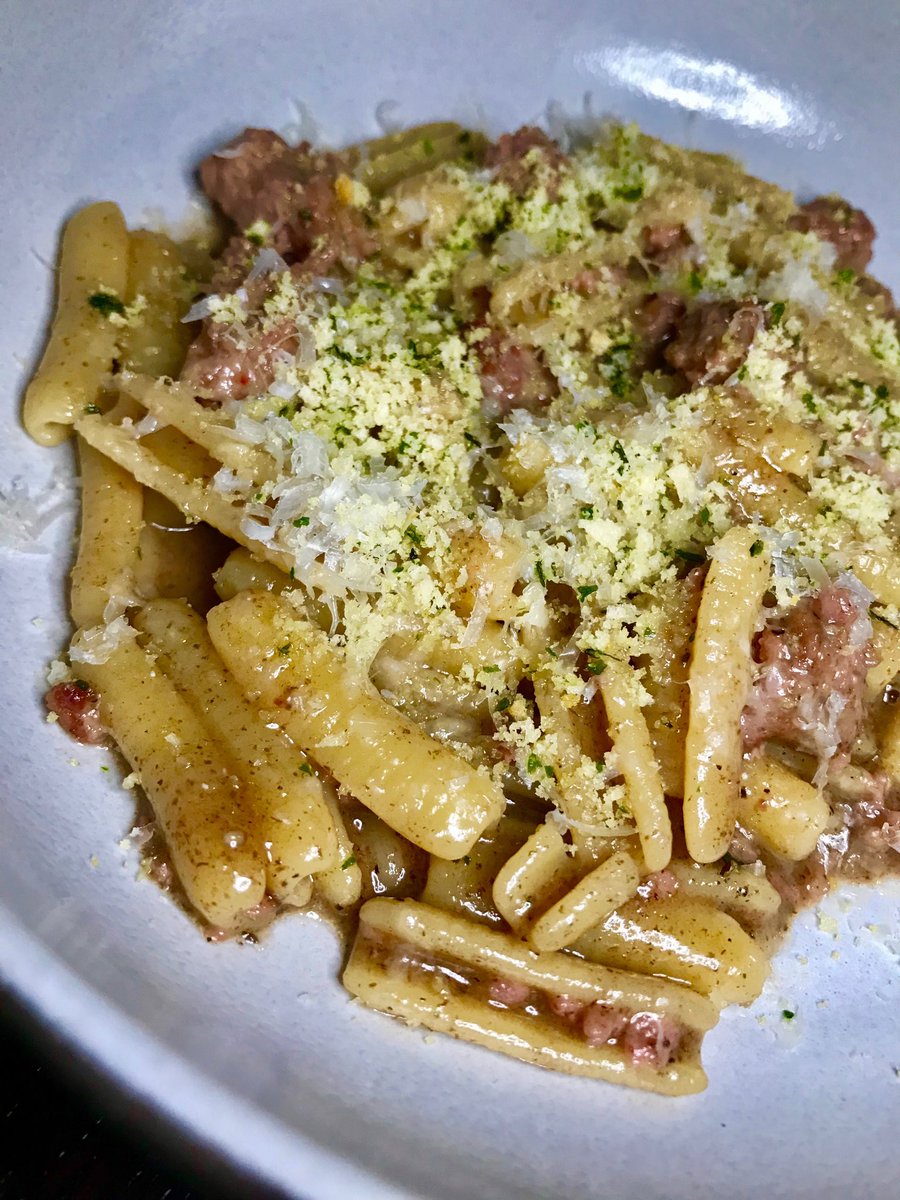
You won’t mind a bit seeing Italian pastas like tagliatelle with crab and lemon ($36) and cavatelli (above) with black truffle and sausage ($28) sitting beside French classics like lobster Thermidor ($64) and beef Rossini ($58), especially when everything is this tasty. Those pastas may not be in the same league as Marc Vetri’s, but the portions are larger and both starches pack a punch.

Before you get to them though, you’ll have to navigate the appetizers. Again, you’ll find a blend of food styles aimed at pleasing the largest swath of customers possible, Thus does rudimentary kanpachi ceviche ($21) share space with an excellent foie gras torchon ($36), while pata negra ham ($38) can be ordered alongside a buffalo mozz/bibb lettuce.

Image may contain: food

Oysters (above, $34) come two ways (chilled with champagne mignonette and broiled with Parmesan and breadcrumbs), and may be the best composed bivalves in town — the first being (literally) sparkling with acidity, while the second finds four plump specimens warmly nestled beneath an herbaceous, cheese blanket. It’s not easy to accent oysters without overwhelming them, and both versions here walk that tightrope without a stumble.

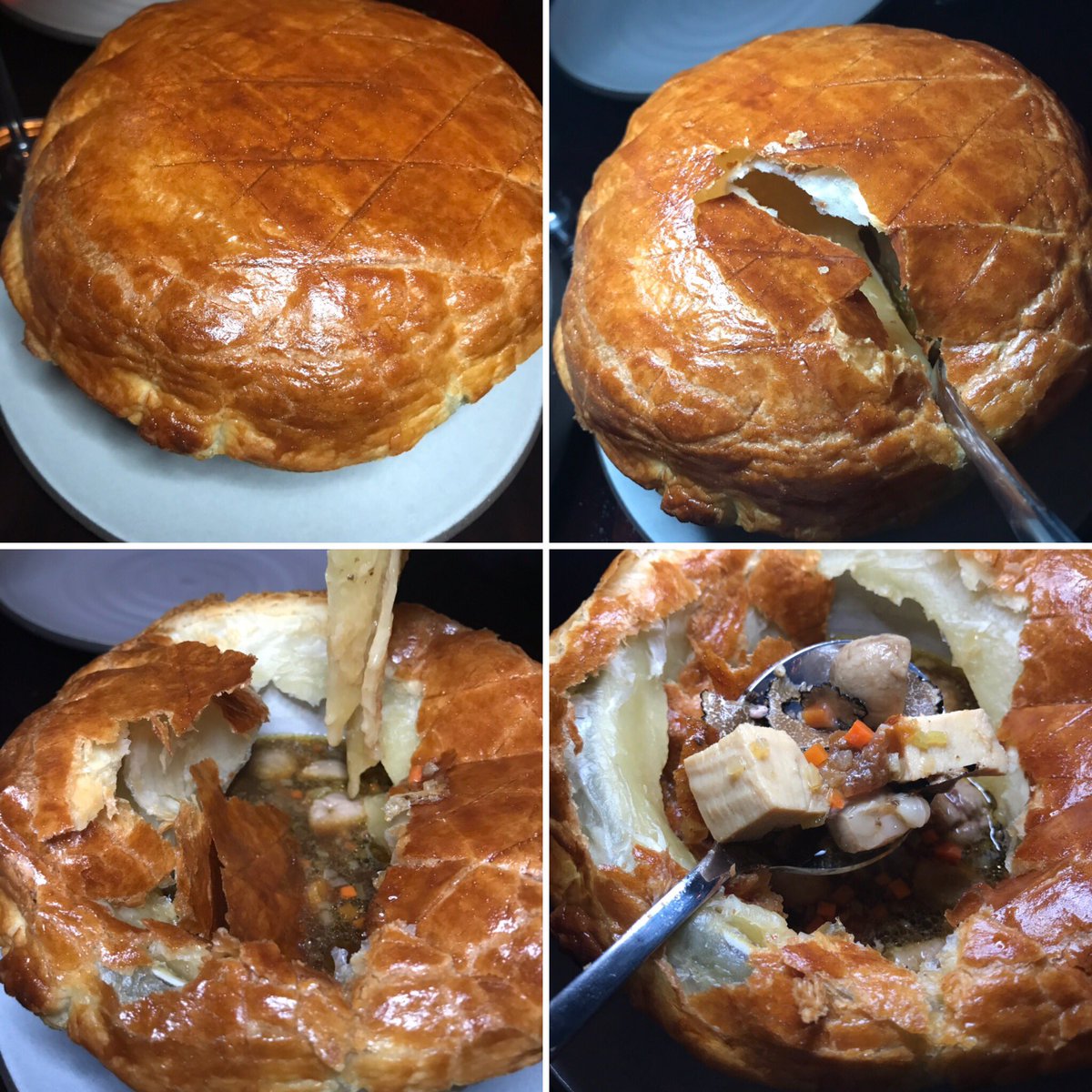
This sort of all-over-the-map eating could be a disaster in less capable hands, but Humm’s crew faithfully recreates the pristine (those kanpachi) with the iconic (Paul Bocuse’s fabled truffled chicken in puff pastry, $32) without a hiccup. The soup is a marvel of simplicity, and any misstep (with the broth, the bird, or the mille-feuille), could turn this homage into a cheap forgery, but as at Auberge du Pont de Collonges, they have obviously honed their skills in making this famous concoction down to a science, and the lip-smacking results are not to be missed by any serious gastronome.

Image may contain: food

If there’s a dish NoMad can be credited with bringing back from the dead, it is the simple roast chicken for two (above). Once a staple of French dining rooms, it fell out of favor in the 90s as two generations of baton-twirling chefs sought to distinguish themselves with whatever cartwheel they could fit on a plate. (When I lamented the loss of the simple pleasures of a perfectly roasted bird to several chefs a decade ago, they all looked at me like I was advocating the return of the tasseled menu.)

The version here has been gussied up to a fare-thee-well, and finds a beautifully bronzed specimen, “stuffed with foie gras, black truffle, and brioche, dark meat fricasse and sauce suprême.” With a description like that, you expect trumpets to be playing when it’s brought to the table. When you taste it, you find a gorgeous bird bathed in a rich cream sauce containing whispers of all the other ingredients rather than a chorus of them. For the price ($94), one expects more. At that price, you deserve the 1812 Overture.


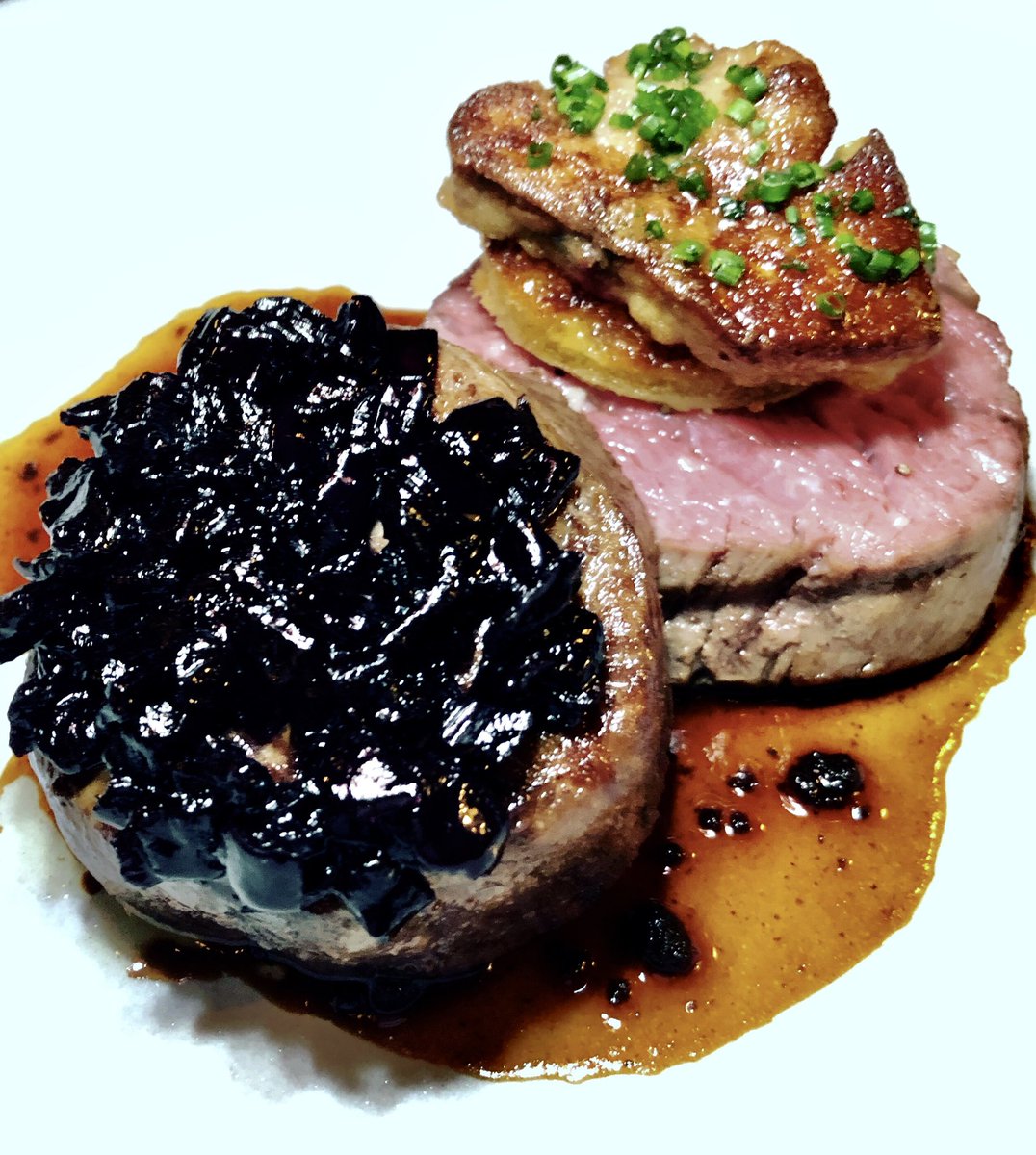
Not to get tacky about it, but cost-to-value ratio is definitely an issue here. $58 brings forth two small tournedos of (probably sous-vide) filet mignon, one topped with a cute piece of foie gras, the other plopped with a black substance that tastes like stewed blackberries but which is, in fact, onion “jam.”

Jelly on meat is one thing, but this invention comes across as a way to distract you from the minimal presence of (the expected, required) truffle flavor in the dish, and an excuse not to use any more foie gras than necessary.

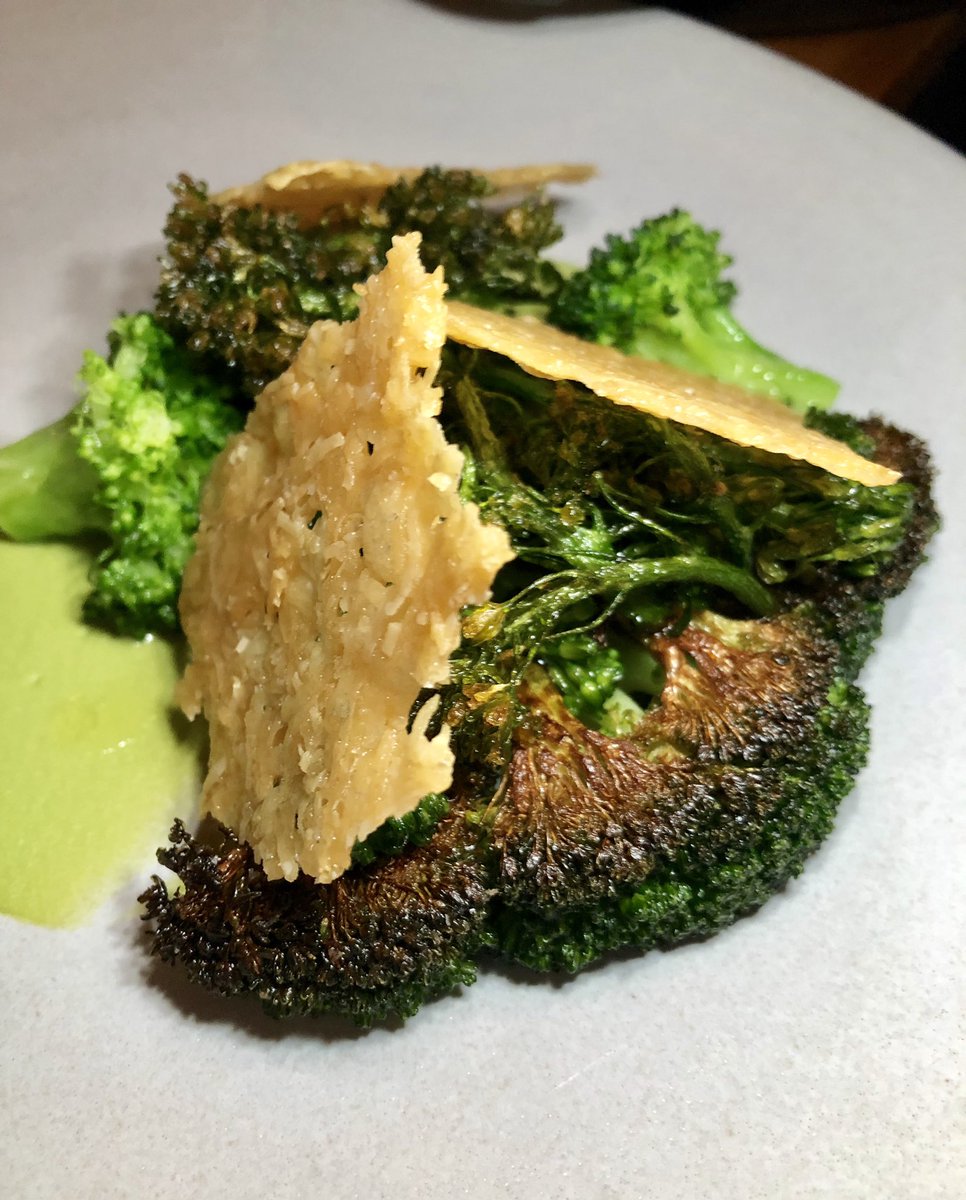
And then you get to the overpriced sides. $18 for a baked potato (mine came with white truffles, I’m not sure everyone else’s does), $15 for sauteed mushrooms, and…wait for it…. $26 for roasted broccoli.  Of course it comes with two little Parmesan crisps as garnishes, so there’s that.

The baked Alaska is no bargain either ($28), but it’s a wonder of layered composition — fruit, cake, cream — flamed tableside to your delight at any price. I would’ve happily paid double for it in exchange for knocking the broccoli off the bill. The chocolate mousse ($14) is scooped tableside from a large bowl and is also drop-your-spoon delicious.

Finally, there is the service. If you’ve followed me for any length of time, you know that I rarely comment on it. This is for two reasons: 1) many restaurants in Las Vegas know me, so, as a result, I receive more attention than the average diner; and, 2) I don’t really give a shit about service. As I’ve said before, I don’t care if they dump soup on my head as long as it’s great soup.

I may not care about service, that doesn’t mean I don’t notice it. No matter where I dine, from a place like Le Cirque (where we’ve been dozens of times) to my two visits here, I’m watching how the waitstaff treats every one around me. How is their greeting? Is the water getting re-filled? Is there a lag between courses? Does the check show up on time? How have they handled a complaint? My gaze may not be riveted on any one table, but my antennae are always out.

And out or in, I couldn’t help but noticing that service here is not commensurate with the prices. It starts with that hostess stand and continues through the meal: a lot of attractive young people scurrying about, but vaguely confused about how to get the job done.

Menus show up haphazardly. Four different people ask you the same question. Long lag times. Liquid replenishment is problematical, and one entree shows up five minutes before another (at a two-top, on a weekday evening with the restaurant not half full). Vegetables appear at random, and a glass of wine ordered with your entree shows up with dessert.

At a more modest establishment, these would be chalked up to growing pains. With this reputation and these pretensions, such failings are inexcusable, or, at the very least, mentionable.

If I seem on the fence about NoMad, it is because I am. There’s a lot to like about the place. Some of the dishes take your breath away, the room is spectacular, and the libations (cocktails and wine) are well thought-out, and a treat. (Someone on the Strip obviously got our memo about wine lists a few years ago, as the lists we’re now seeing —  here, Vetri, Cipriani, Scotch 80 and others — are stocked with more bottles in the $50-$125 range.)

But if the true test of a restaurant is whether you want to come back, I don’t see myself trekking here anytime soon. I may be looking forward to my next Vetri adventure, or plowing through pastas at Cipriani, or diving into dumplings at China Mama, but when it comes to NoMad, I think I’ll stick with the hamburger and the hot dog  being sold next door at the NoMad Bar, and leave the fancy dining to those who don’t mind paying twenty-six bucks for a bunch of broccoli.

(Our two meals – for two – came to $521 and $325 respectively, but the first one included a $140 bottle of wine. Expect to pay around $125/pp, exclusive of booze.)

THE NOMAD RESTAURANT

The Park

3772 Las Vegas Blvd. South

Las Vegas, NV 89109

702.730.6785

https://www.nomadlasvegas.com/en/restaurants/the-nomad-restaurant.html


PARTAGE

(The Three Musketeers)

A Francophile’s dream come true. The chefs are French, the decor is French, the bartenders are French and the food is as French as Bastille Day. And the whole enchilada is in Chinatown. Go figure.

When Vincent Pellerin, Nicolas Kalpokdjian, and Yuri Szarzewski (above) came to the United States in 2015, they had a dream — they wanted to bring healthy French food to Las Vegas. Anyone with a brain would’ve told them the idea had as much chance for success as a Mormon nightclub, but arrive and succeed they did, first with their casual EATT Gourmet Bistro on West Sahara, and now with a more upscale (but still very laid back) place in a shopping center more at home with massage parlors and noodle shops than croque monsieurs and Pays Nantes.

Because it’s in Chinatown (in the old Chada Street space) the curb appeal is practically nil….and so is the parking. (At busy times you may have to inch your way around the lot once or twice to find a space. If ever there was an off-Strip property begging you to take a LYFT to it, this is it.)

The signage is as simple as the storefront and gives not a clue as to the wonders behind the long glass facade. But as soon as you step through the doors, you can sense that magic is about to happen. Seating are plush but not too so. Cozy booths line one side of the room and a long L-shaped bar dominates the other. The lighting is dim (but not too dim) and flattering, and even at peak occupancy, you can still hear yourself think and talk.

Towards the back you’ll see a large window behind which the chefs operate, and a glass wine room holding the all-French, all-nicely-priced selections. While the list isn’t long, it’s broken down by region (Alsace, Burgundy, Bordeaux, etc.) and the bottles are marked up 100% over retail, rather than 2-300% gouges you’ll find a mile to the east. Another thing I love are the easy to read prices ($65 for a Gigondas; $120 for Dom Ruinart, etc.) with none of that $59 v. $63 nonsense you see at the big hotels. (I’d love for some wine director to edify me sometime on why one Cali cab is priced at $118, while another fetches $121. Is it because there’s a 2.8% difference in quality between the two bottles? Ridiculous.)

Partage means “to share” and the menu encourages you to do just that. 20 small plate options are offered, each amounting to no more than 2-3 bites of headliners like halibut ceviche (disguised to look like dragon fruit):

….or a single lobster ravioli in a small cup of bisque, or perfect, meaty scallop swimming in a dashi broth with seaweed chutney and steamed leeks. Everyone seems to feature trilogies of oysters these days (whassup with that?), but the version here is top drawer, with the yuzu hollandaise being the one you’ll remember. As good as they are, the real stars of the show are the salmon croquettes (almost Japanese in their deep-fired, ultra-light crispiness):


…and the squid “risotto” — the risotto in this case being finely diced pieces of squid bound together by a barely-there pesto, filled with flavor but not filling you up.

If you’re looking for richness, Szarzewski has you covered. His sweetbreads are a godsend for lovers of all things thymus — accented by lotus root and a smooth tonka bean cream — the tight little sauteed gland giving not a hint of how dense and filling this offal can be. For pure decadence though, nothing beats his oxtail croque monsieur — long simmered meat, slicked with bone marrow,  served between three batons of the world’s most luxurious toast:

If hunger still lingers after these (doubtful), tuck into a quail leg garnished with umeboshi and foie gras, or a few nibbles of good Spanish pata negra served with a small puck of olive oil cake and fennel sorbet:

Jamon platters are everywhere, but this little one may be the cutest of the bunch.

The anti-ham crowd will enjoy digging into things like ratatouille-stuff squash blossoms, burrata Caprese salad, a melange of root veggies, and the best damn pea soup you’ve ever slurped — this one given a kick by lemon-basil sorbet and finger limes.

About the only dish I can’t recommend is the king crab coated with black garlic. It tastes of pure, sweet crustacean slicked with the tamarind-like essence of aged allium, but it looks like something the cat left behind. If there’s an award for the best tasting, least attractive dish in town, this would litter-ally win by a landslide:

(Honey! The cat’s been at it again!)

Large groups will want to go large format with big cuts of 18 ounce rib eye, or a 32 ounce tomahawk steak — smoked with either hickory, applewood or hay (your choice!). Two pound lobsters and whole duckling breasts served on the bone, and sea bass baked in salt crust is also offered for the whole table to swoon over. In keeping with the “healthy French” thing, sauces are kept to a minimum. Not to my taste, exactly — the duck, pork and bass suffer from the lack of liquids — but the presentations are in keeping with how modern French food is done these days.


Desserts are a dream, and Pellerin’s rolling cart (above) is not to be missed. Whether he’s doing a baba au rhum (injected at table with some high proof spirit), a caramel candy bar, or a flaming baked Alaska (below), you can be assured no one, in any neighborhood in Vegas, is eating a dessert as good as the one you’re getting. Pastry chefs are an endangered species these days, and having one as accomplished as Pellerin working in the ‘burbs is quite a statement for a local joint.  His macarons (when available) should be ordered by the dozen.
(Like this baked Alaska, Chinatown is en fuego!)

Las Vegas came of age as a restaurant town in 2018, and exhibits 1-4 are Sparrow & Wolf, Mordeo Wine Bar, EDO Tapas, and Partage. By recognizing the true foodie potential of Chinatown, these venues have broadened its horizons and done the same for serious gourmands — local and tourist alike. Partage may not be for everyone (the food might be a little too precious for the meat and potatoes crowd) but it’s given a boost to our dining scene in all the right ways. Vive la France!

PARTAGE

3839 Spring Mountain Road

Las Vegas, NV 89102

702.582.5852

https://partage.vegas/