YUZU Kaiseki Excellence


It took me two years to make it to Yuzu Japanese Kitchen.

Two years.

Sounds incredible even to me, since I pride myself in seeking out the best Japanese food in town, as soon as it arrives in town.

But I have an excuse. (It’s a lame one, but I’m stickin’ with it.)

And that excuse is: Yuzu is located on Silverado Ranch Boulevard. Yeah, that Silverado Ranch Blvd. — the one located way southeast of the Strip; the one littered with poker bars and fast food franchises. The street that considers the South Coast Hotel and Casino a fun time anchor tenant. A restaurant wasteland so vast it makes Henderson seem like Napa Valley.

You normally couldn’t get me on Silverado Ranch with a shotgun in my mouth and promise of free foie gras, but my buddy Martin Koleff told me I had to try Chef Kaoru Azeuchi’s cuisine, so off we were — twice in two weeks — to see for ourselves.

Martin and Rie Koleff, you may recall, are something of a Japanese restaurant power couple in Las Vegas. They both are long time veterans of our hotel F&B scene, and Martin was instrumental in first putting Raku on the national map. These days they are both involved in bringing the Joy of Sake event to Las Vegas, and if there’s such a thing as a Japanese restaurant mafia in town, the Koleffs are the capo di tutti capi to numerous chefs and restaurateurs, many of whom are not as fluent in English as they are.

When Martin or Rie tells us we have to try someone’s food, we listen. Usually. Unless it’s on friggin’ Silverado Ranch Boulevard, where, truth be told, we thought Azeuchi-san’s chances of survival were slim. But survive he has, prospered even, in his almost-hidden haunt behind a car parts store.

He’s done it by doing what so many non-Japanese chefs are afraid or unwilling to do: food his way, writ small, night after night, until he his audience slowly finds him. (Chefs are always telling me how they just want to open a little place and serve their favorite dishes. Yeah right, I always think to myself. With a few exceptions, the only people with the guts to go small and be patient are Asians in general and Japanese cooks in particular.)

Yuzu may be small, but what it’s doing is a very big deal, indeed. It’s not strictly a sushi bar (although there is a small one), and it’s not an izakaya in the Raku or Izakaya Go mold. What it is is our most Japanese of restaurants. A place that could be right at home in a Shinjuku alleyway; a place serving food so true to the rhythms and tastes of Japan that it’s almost shocking when a gaijin walks through the door.

There are many reasons to go here, the passion of the chef and quality of the ingredients being first and foremost among them. The Food Gal® tells us the noodle and teriyaki bowls at lunch are first class, but if you really want to see Kaoru-san strut his stuff, you need to reserve in advance for one of his kaiseki meals.

For the uninitiated, kaiseki refers to a very specific form of Japanese dining. It is the haute cuisine of Japanese cooking — seasonal eating taken to the nth degree — a multi-course meal that combines the artistry of the chef with a myriad of ingredients, presentations and techniques. Everything (and we mean everything) from the garnishes to the plating is thought through and presented in a way to enhance every sense — visual, aromatic, taste, tactile — that goes into your enjoyment of the meal. Many of the elaborate garnishes are symbolic, and all of the recipes try to achieve a zen-like state of communion between the diner and the food.

In other words, it doesn’t get much more complicated or serene than a kaiseki meal, but in the right hands, it is a transporting experience — creating an almost blissful connection between chef, raw material and consumer. There is nothing like it in Western dining, although the elaborate tasting menus of Keller, Achatz, Humm and others pay homage to kaiseki, none of them achieve the transcendence of  the Japanese chefs, who have been at it centuries longer. (Americans are too busy doing cartwheels in the kitchen and padding your bill.) Azeuchi trained for 16 years as a kaiseki chef in Japan, even getting the honor of serving the Emperor, so, needless to say, you’re in good hands.

What you will get will always depend upon the season and the chef’s inspiration, but whatever path is chosen by the chef, it will no doubt be the most delicious Japanese food you’ve ever had.

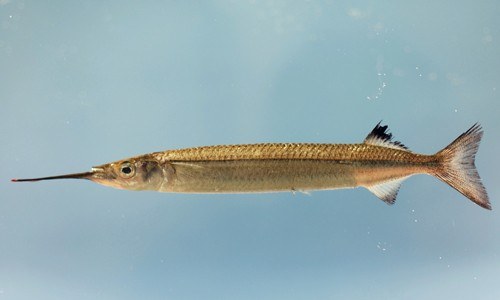
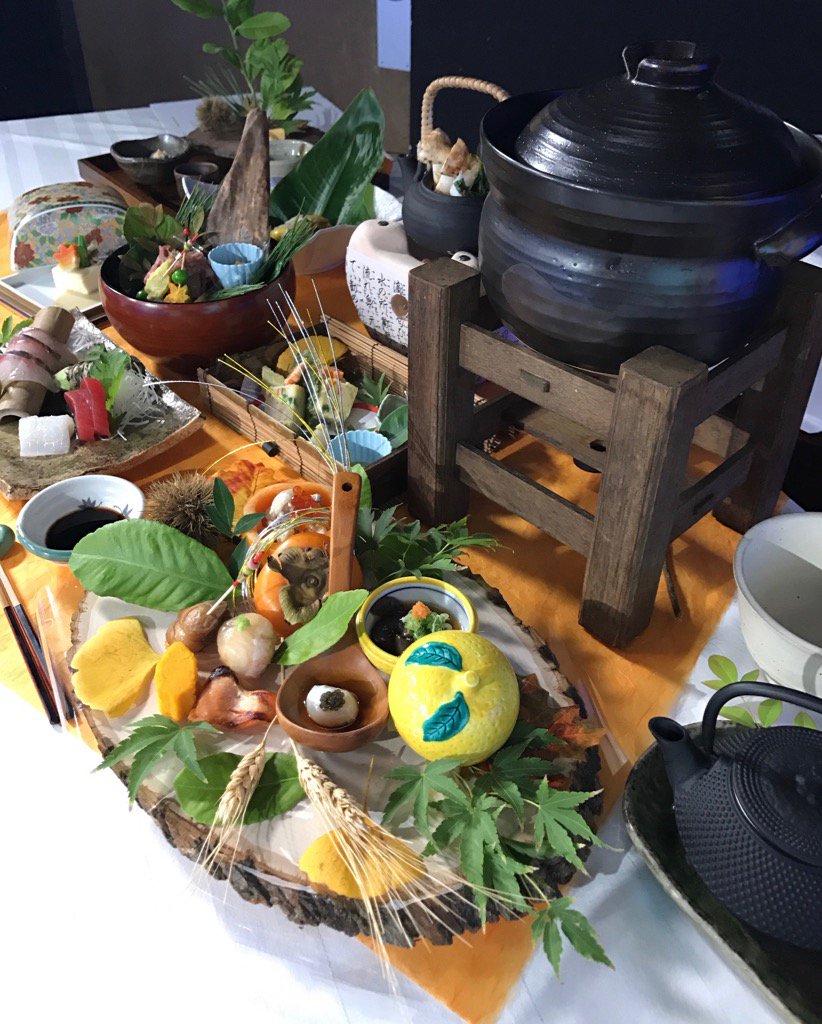
Our dinner started with the appetizer platter above, containing everything from an ethereal poached egg with caviar to grilled barracuda to uni rice topped with red snapper. From there, we proceeded to a sashimi platter of lobster, striped jack and halfbeak that was the equal of anything you’ll find at Kabuto and Yui:


Then came the queen of all mushroom soups: a dobin-mushi matsutake broth containing pike conger, cabbage and shrimp:
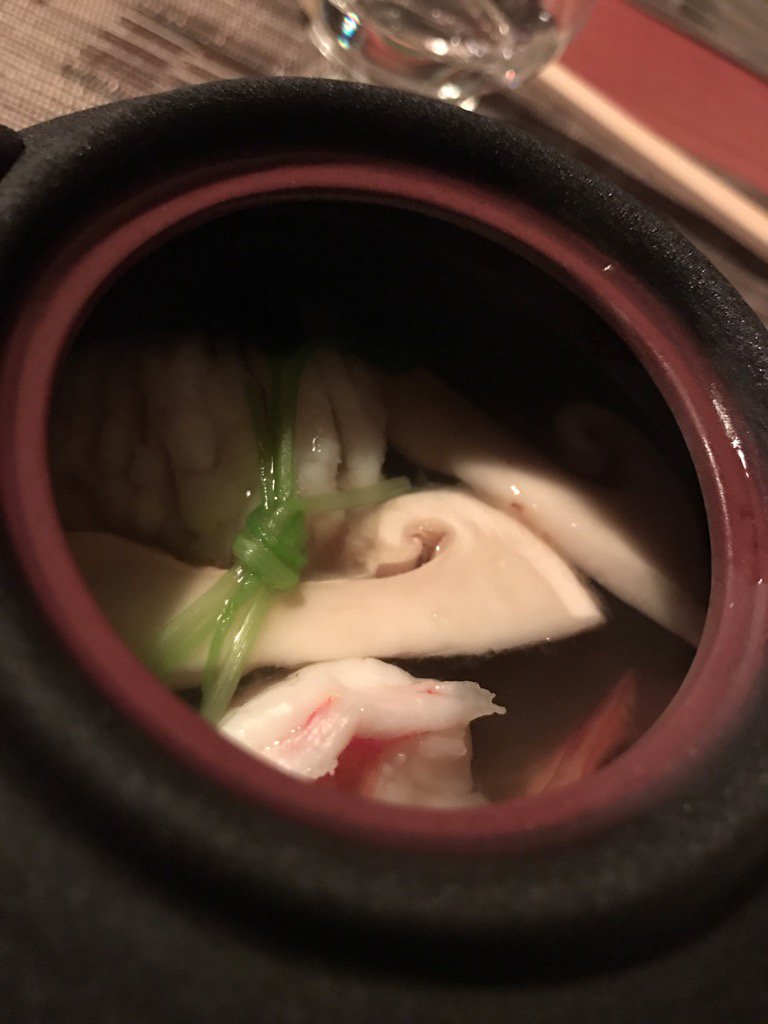
It was a soup so startling in its deceptive, smoky simplicity that everyone at our table was shaking their heads in appreciation.

From there we progressed through six more courses, ranging from grilled ribbons of A-5 Miyazaki wagyu (wrapped around more ‘shrooms and wasabi), to a steamed dish (steamed scallop cake draped with a latticework of wheat gluten), to eel tempura, to a “vinegar dish” of seared mackerel that was a bracing combination of tart and smooth:
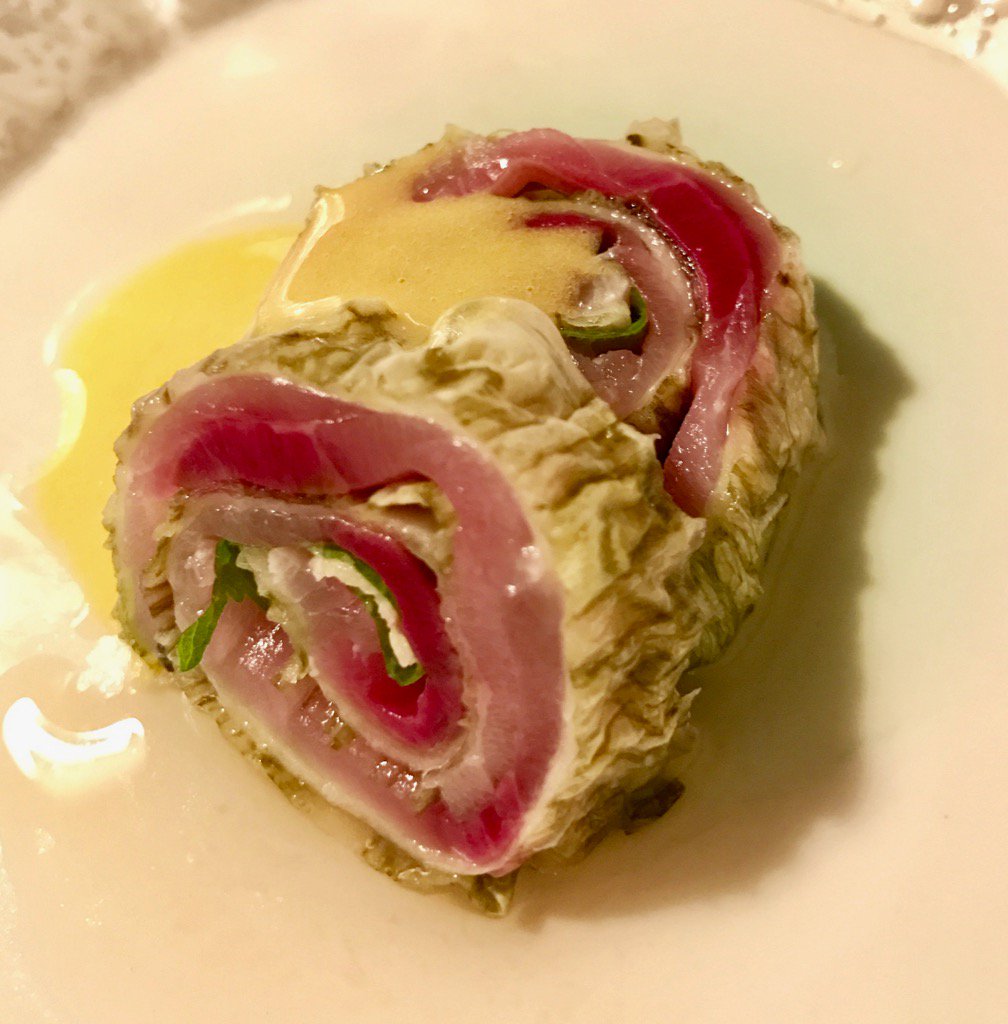
Each dish was a model of precision, and each left you hungry for more. A big deal is made of the rice dish, for good reason. Rie Koleff (who acted as our personal sake sommelier throughout the meal*) explained that rice always signifies the ending of the meal Japan. This dish was, like much Japanese food, subtle to the point of invisibility:
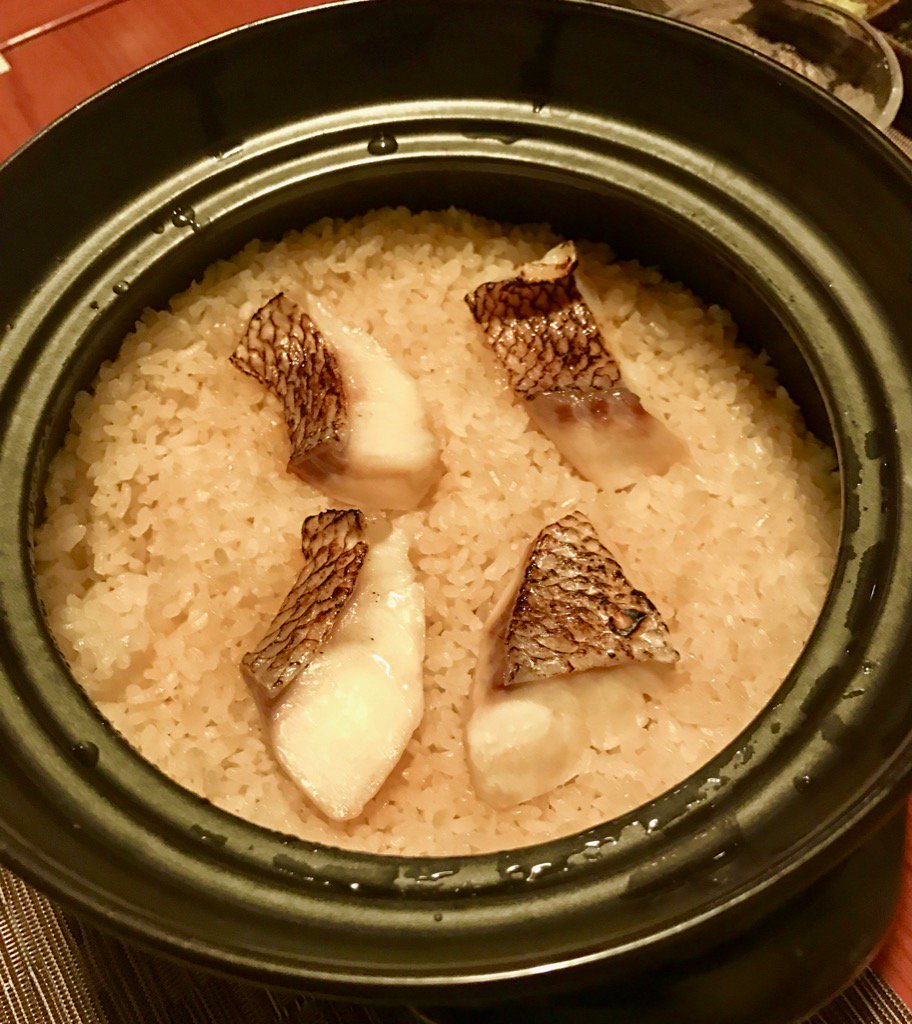
….but like much Japanese food, once you stop looking for in-your-face flavor, and start appreciating the nuances, you quickly find that you can’t stop eating it. I don’t think a simple bowl of rice and fish can taste any finer, or be found anywhere in Las Vegas.

Those nuances are the key to Japanese eating. I call it deceptive simplicity because you are always getting much more than meets the eye. Especially in a kaiseki meal. Here, you are treated to an education in the centuries-old traditions in the Land of the Rising Sun: the reverence for seafood, the harmony of vegetables and the keen awareness of the seasons. In a nutshell, everything that Las Vegas is not. This is eating as a form of secular religion, and if you’re open to the experience, you will be transported in a way that no other Western meal can match.

The kaiseki at Yuzu is not a formal affair. (You are on the outskirts of Hendertucky after all.)  Because Kaoru-san flies in many ingredients from Japan, it is necessary to book at least three days in advance. The price you want to spend determines how elaborate it’s going to get. The ten-course, sixteen dish affair we had runs about $175/pp, but for $50/pp you can get a fine introduction into one of the greatest dinners in all of Las Vegas. ELV’s meal was comped.

YUZU JAPANESE KITCHEN

1310 East Silverado Ranch Blvd.

Las Vegas, NV 89183

702.778.8889

http://www.yuzujapanesekitchen.com/


* There is a nice selection of sakes on hand but you will probably not get your own sake sommelier. Sometimes, it’s good to be king. ;-)

Mandalay Bay is Back, Baby!

https://media-cdn.tripadvisor.com/media/photo-s/0a/c3/30/a1/man.jpg

You remember Mandalay Bay, don’t you? It was once a mega-hotel on par with the Wynn, Bellagio, and Caesars Palace when it came to top-shelf, drop dead delicious food. When it opened in 1999, it boasted a murders row of chefs and restaurants that went toe to toe with the likes of Le Cirque, Picasso, Michael Mina and anything Wolfgang Puck, Emeril, or Bobby Flay could throw at you. Piero Selvaggio had a pasta shop in the mall that was second to none, Hubert Keller killed it nightly in a gorgeous room,  and Rick Moonen could sling the freshest of fish with the best of them. When Alain Ducasse crowned the top of THE Hotel with his miX Restaurant and Bar in 2004, it capped one of the most impressive lineups of chefs (absentee or otherwise) of any hotel in the country.

Then, something happened. Call it complacency, call it competition, but when Joël Robuchon, Guy Savoy and Pierre Gagnaire planted their flags here between 2005-2009, you could almost feel the wind go out of the MB sails. And when the recession of 2008 hit, something really happened. The high end customer base shrank considerably (there’s only so many aspirational gourmets out there ready to pay big bucks for fancy food), and pretty soon the entire hotel seemed to go into a downsizing funk. Charlie Palmer’s Four Season steakhouse was eclipsed by a dozen others, miX and Moonen’s high-end seafood lost their audience, and Aureole got stale. Before you could say “credit default swaps,” Fleur de Lys threw tacky “art” on the walls and started serving tacos, and the entire hotel looked like it was headed to the middle-brow mediocrity of Luxor-land.

Well, praise the lord and pass the mashed potatoes, because things have changed.  Moonen re-booted himself with his rX Boiler Room (and by bringing in the talented Sean Collins to run both it and his seafood cafe), Charlie Palmer STEAK has gotten a facelift and a menu lift (from chef Tom Griese), and the new Libertine Social blends the dynamic cooking duo of Shawn McClain and Richard Camarota with über-mixologist Tony Abou-Ganim into a zeitgeist cocktail of haute casual eating and drinking. Add to this the continuing excellence of joints that have never wavered — Border Grill and Strip Steak — and you have a hotel that has recaptured its mojo. Even that old warhorse Aureole is getting into the act, re-doing the decor and bringing in local legend Johnny Church to rejuvenate the kitchen.

I still haven’t forgiven the F&B bigwigs for what they forced Fleur de Lys to do (go from fabulous French to so-so small plates), and what Ducasse did with miX is inexcusable (it’s now an overpriced Italian restaurant that looks like a coffee shop, albeit one with the greatest view in town), but with the veteran Emmanuel Cornet now in charge of food and beverage, I’m starting to think Mandalay Bay might once again become my go-to food and booze hangout, just like it was a decade ago.

Tasting the Traube Tonbach

https://gourmoer.files.wordpress.com/2014/11/traube_tonbach_baiersbronn_15.jpg

ELV note: We know the title of this web site is “Eating Las Vegas,” but we also know that you know that we do not confine ourselves simply to the pleasures of dining in Sin City. Indeed, we travel the world, calibrating our palate to the cuisines of its greatest chefs, the better to give us (and you) a baseline from which to judge all great restaurants. Below is our love letter to the enchanting hotel we visited late last year in Germany’s Black Forest (“Schwarzwald” – pronounced SCHVARTZ-vald). We hope you get a chance to visit there someday, but even if you don’t, we hope you will take some pleasure in living vicariously through our travels, and through these words and pictures.

There’s a lot to do at the Traube Tonbach. Spas, swimming (indoors and out), skiing, hiking, exploring the picturesque valleys and towns of Baiersbronn, all await you, all while taking in some of the crispest, cleanest, pine-scented air in the world.  If you’re the shut-in type, you’ll find nothing to complain about either. The 153 rooms are enormous, the bathrooms even more so, and it seems everywhere you look (out of giant, wood-trimmed windows) you see one stunning, forest view after another.

Calling the Traube enchanting is an understatement. From the traditional Tyrolean garb of the crackerjack staff:

…..to the oversized, Black Forest decor, everything about it has a formal-yet-friendly precision that seduces you from the moment you sink into an overstuffed chair or start sipping a crisp glass of Riesling. You can be as laid back or active as you wish at the Traube Tonbach, but what you really ought to be doing is eating.

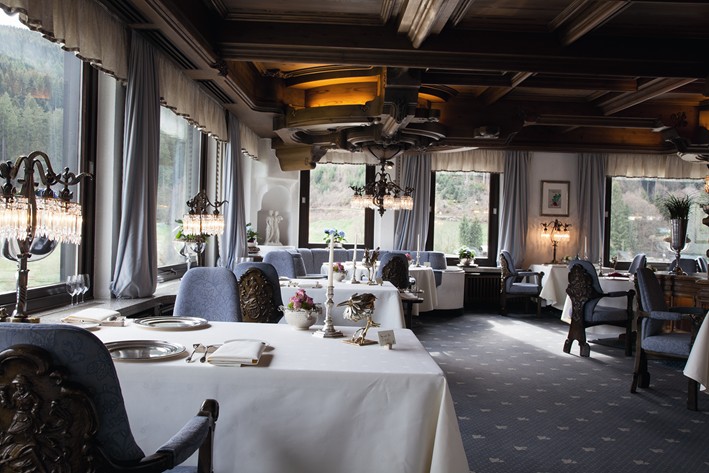
Harald Wohlfahrt’s Schwardwaldstube (pictured below) has held three Michelin stars since 1992. The name means “Black Forest Room” and the thickness of the wood, the chairs and the linens give not a clue as to the lightness and freshness of his cuisine.

room

The room only seats 40 customers, but so precise is the food, you get the feeling that there are at least that many cooks in the kitchen. Wohlfahrt told me (through an interpreter) that his cuisine has become more international over the years, and like most chefs in this league, he now plays with flavors from around the globe. Some might fault him for letting these flights of foreign fancy overtake him, such as when he accompanies beautiful poached Gillardeau oysters with ponzu jelly, shredded beetroot and horseradish, plus a chives vinaigrette, but to my mind, everything harmonized the way it’s supposed to with highfalutin fusion food. What Wohlfahrt’s elemental, not-bashful cooking told me was that I was in a bigger, bolder, German version of a French restaurant, not a dainty Gallic one.

“Not bashful” would be my same description of the Swabia-meets-Bologna construct of  Wohlfahrt’s ravioli. Stuffed with a moist, dense, “confit” of calves head, and garnished with sweetbreads, and tongue — it was elegant and earthy, not an easy feat in any language. Festooned with truffles, it was part French, part Italian, and definitely Deutsch, and genuflected to all three cuisines without surrendering to the heaviness of its pedigree.

 From there, our meal proceeded seamlessly through meaty slices of wild turbot in an intense, sea urchin nage, through local “homegrown” venison in a juniper sauce that tasted of a hunter’s bounty, if he happened to be a Michelin-adorned superstar. This is cold weather, nip-in-the-air eating at its finest, I thought to myself — food that matched the evergreen forest surroundings as much as the heavy, carved wood upon which we sat.
 As wonderful, and of-its-place as our game and fish repast was, it was my wife’s vegetarian meal where the kitchen really proved its mettle. Six courses of jaw-dropping variety that were even more stunning than the proteins — variation of carrots in a black tea emulsion, grilled pineapple and confit of fennel in a Ricard Pernod/passion fruit stock, and a potato-mushroom ravioli with caper jus and chanterelles — any and all of which could make you forget about meat altogether. This sort of high-wire, multi-dimensional, vegetarian cooking proves how exciting vegetables can be when placed in the right hands. As with my meal, every course was a show-stopper, but the highlight was an egg white souffle encasing a reinserted yolk with a white truffle sauce so intense I had to check my pulse.

About the only clinkers in the meal were the desserts, that seemed terribly overwrought — almost as if the pastry chef was trying too hard to keep up with the pirouettes taking place on the savory plates — and a serious service lapse towards the last quarter of the meal, when everything seemed to slow to a crawl. To be fair, there were several large parties in the restaurant, all of whom were spending way more money on wine than we were, so that may have backed up the kitchen. By the way, this was the third Michelin 3-star meal I’ve had in the last year — the others being at Meadowood in Napa Valley and Auberge de L’Ill in Alsace — where the highly visible and solicitous maitre’d seemed to disappear from the dining room for the second half of the meal. Perhaps this is the 21st Century job description: show up, look good, kiss hands, and then vanish. Or perhaps these impeccably groomed face men have second jobs posing in department store windows. Either way, it strikes a small, discordant note where there should be none.

As for wine, the list is extensive (750+ labels, 36,000 bottles) and shoulder deep in great German and Alsatian Rieslings.  Markups were more than fair — especially compared to New York and Las Vegas — with dozens of great bottles for 100 euros or less. My rule of thumb when star-grazing in Europe is to look for bottles in the 50-100 euro range, and I’m consistently amazed by the quality at those prices. I took the wine pairing with my degustation, and it, along with our young sommelier (who didn’t disappear from the room) was superb.

http://www.traube-tonbach.de/media/traubetonbach/img/dyn/e70807b638e247b783f547652f4cbe94.jpg

The Schwarzwaldstube would be a fitting crescendo to anyone’s visit to the Traube, but we worked in reverse order for our two day stay. Dinner number two found us again across the street from the main hotel (at the original, heavily timbered inn that now houses the “Black Forest Room,” an international restaurant (that we didn’t try), and a traditional restaurant (the Bauernstube) that we did. Those timbers, low ceilings, plaster walls and wooden benches give the Bauernstube (pictured above) a distinctly 18th Century feel, but this being the Traube, the linens are as thick and crisp, and the table ware every bit as formidable (if several clicks more casual) than at its starred sister restaurant down the hall. They share the same wine list, and the food is every bit as satisfying and rib-sticking as you would expect southwestern German food to be.

Being strangers to Swabian cuisine, we didn’t know what to expect, although we suspected that the six mile hike we took earlier in the day was probably a good idea. As with every German restaurant, the difficulties of the language are always looming to surprise you with a disconnect between what was described, what you thought you ordered, and what shows up. For example: three, fist-sized stuffed ravioli are described as a “snack” on the menu, but what appears could fill up a sumo wrestler.

(In a similar vein, a chef once told us he mistakenly ordered a plate of butter as an appetizer in a German restaurant.)

Undaunted by our “snack,” we sallied forth with the rest of our meal and found everything to be as enjoyable as a meal of golf ball-size sweetbreads (used to “garnish” a perfect blanquette de veau, no less), tennis-ball sized liver dumplings, football-sized noodles, and brook trout can be. The trout tasted as if it had jumped right from the stream onto our plate (because it almost did, we were told), and, filling or not, those dumplings, veal and sweetbreads are two dishes I’m still dreaming about.


My parents told me decades ago about the wonders of German breakfast buffets in upscale hotels, but it wasn’t until I forced myself into an early awakening on my second morning here that I saw what they were talking about.

https://media.hotelwebservice.com/media/traubetonbach/img/dyn/dfafc065c2ac482cab443ed000f17e9d.jpg

“Get here early,” one of the staff told me, and so I did, bleary-eyed and still wrestling with my weightlifter’s repast of the night before.

What I confronted was more temptation than any one man should face while he’s still digesting Swabian dumplings: Every bread and pastry imaginable, right out of the oven. Miles of meats, cheeses, fruits, jams, and jellies. Scores of butters and spreads. Eight kinds of milk. A dozen fresh-squeezed juices. Every kind of smoked fish you’ve ever heard of and more sausages than you can shake a stick at. Carved beef, cured ham (four kinds!), smoked ham, eggs out the wazoo and half a dozen local honeys. Aged fromage from all over Europe, and did I mention the pastries and meats?


And the wurst was yet to come!

 Forgive me, but I’ve waited twenty years to use that joke in a food article, so you’re stuck with it.

Everything from the coffee to the head cheese was exemplary, and the finest of its kind of any buffet I’ve ever been to. It was so good it restored my faith in overeating.

My parents were right: The Germans do breakfast better than anyone. Their hotels and 3-star restaurants concede nothing to the French, either, with everything correct down to the last detail. Michelin is right too: this magical place is definitely worth a special journey.

Our dinner for (two tasting menus + one wine pairing) at the Schwarzwaldstube came to 461 euros including a generous tip. (Yes, they tip in Germany, usually around 10%.) The Bauernstube dinner was 108 euros, and I don’t remember what the breakfast buffet cost, but it’s worth anything they want to charge for it.


HOTEL TRAUBE TONBACH since 1789 – Familie Finkbeiner KG
72270 Baiersbronn im Schwarzwald, Germany, Telephone +49 (0) 74 42/4 92-0, Reservations +49 (0) 74 42/4 92-6 22
Fax +49 (0) 74 42/4 92-6 92, reservations@traube-tonbach.de, info@traube-tonbach.de
Facebook Hotel Traube Tonbach – Baiersbronn